
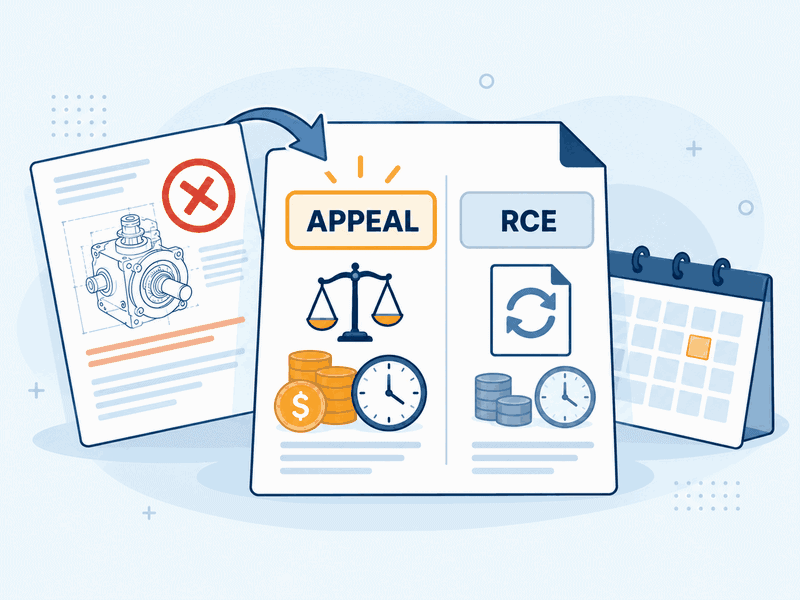
An ex parte appeal PTAB proceeding may make more sense than another request for continued examination (RCE) when the examiner and applicant fundamentally disagree about patent law, claim interpretation, or the cited prior art. An RCE is generally more useful when new evidence, substantive claim amendments, or further examination could resolve the rejection without Board review.
A final rejection from the United States Patent and Trademark Office (USPTO) does not necessarily end a patent application. Instead, it presents a strategic choice: continue prosecution before the examiner or ask the Patent Trial and Appeal Board (PTAB) to review the rejection.
Both options involve costs, deadlines, and uncertainty. The right approach depends on what remains disputed, the application’s prosecution history, and whether further examination is likely to accomplish anything useful.
Key Takeaways
- Appeal when the dispute concerns the existing record. A PTAB appeal may be appropriate when the examiner allegedly misinterprets claims, prior art, or applicable patent law.
- Choose an RCE when further examination has a purpose. Meaningful amendments or additional evidence may justify continued prosecution.
- Compare the full costs. Large entity USPTO fees total $3,440 for a standard appeal through forwarding, compared with $1,500 for a first RCE or $2,860 for subsequent RCEs.
- Track every deadline. Appeal briefs, reply briefs, forwarding fees, and post-decision actions follow different timing rules.
- Consider early review. The USPTO’s Pre-Appeal Brief Conference Pilot Program may resolve certain disputes before a complete appeal brief is required.
When Does an Ex Parte Appeal to the PTAB Make Sense?
An ex parte appeal allows an applicant to challenge an examiner’s rejection before the PTAB. Under MPEP § 1204, claims generally become eligible for appeal after being twice rejected. A final rejection commonly creates this opportunity, although finality is not always required.
The key question is whether the applicant can demonstrate an identifiable error using the existing prosecution record.
Appeal when the examiner’s reasoning is disputed
An appeal may be appropriate when the examiner and applicant disagree about what a cited reference teaches, how particular claim limitations should be interpreted, or whether a rejection satisfies the applicable legal requirements.
Common grounds for considering appellate review include:
- The examiner identifies a claimed feature in prior art that the applicant believes does not disclose it.
- The examiner combines references without adequately supporting the stated reasoning.
- The examiner relies on a claim interpretation the applicant believes conflicts with the specification or applicable law.
- The applicant has repeatedly explained a distinction, but the same rejection remains.
These disagreements can be suitable for Board review because they focus on the examiner’s interpretation of the record rather than new material the applicant wants to introduce.
A persuasive appeal must do more than state that the examiner is wrong. The appeal brief must identify specific errors and explain their significance to the rejected claims.
Choose an RCE when the application needs more work
An RCE permits continued examination under 37 CFR 1.114.
It may be more appropriate when the applicant needs to amend claims substantially, submit additional evidence, or obtain examination of a revised claim set.
For instance, an applicant might recognize that the rejected claims cover more subject matter than is commercially necessary. A carefully developed amendment could distinguish the cited references while retaining meaningful protection.
In that situation, continued examination may be more productive than defending claims the applicant already intends to change.
For background, see what patent prosecution involves and how applicants approach responding to a USPTO office action.
How many RCEs have already been filed?
Previous RCE filings should influence the decision.
A first RCE can be reasonable when the applicant has identified a meaningful amendment or additional argument. A second or third deserves closer examination if prosecution continues to produce substantially the same rejection.
Review what changed during earlier examination cycles. Did the examiner introduce new references? Did the applicant narrow the claims? Were new patentability issues identified?
If the same disagreement persists despite repeated responses, another RCE may add expense without addressing the underlying problem.
Budget also matters. Even a potentially strong appeal may not make commercial sense if the disputed claims have limited value relative to the expected professional and government fees.
Patent Appeal vs RCE: What Are the USPTO Fees?

The patent appeal vs RCE comparison begins with government filing fees. Attorney fees and additional prosecution expenses must be evaluated separately.
Official USPTO fees for appeals and RCEs
The following amounts are listed in the official USPTO fee schedule, effective January 19, 2025. The accessible schedule identifies an August 1, 2026 revision date.
| Filing or action | Large entity | Small entity | Micro entity |
|---|---|---|---|
| Notice of appeal | $905 | $362 | $181 |
| Appeal brief filing fee | $0 | $0 | $0 |
| Appeal forwarding fee | $2,535 | $1,014 | $507 |
| Total standard appeal filing and forwarding fees | $3,440 | $1,376 | $688 |
| First RCE | $1,500 | $600 | $300 |
| Second or subsequent RCE | $2,860 | $1,144 | $572 |
| Optional oral hearing request | $1,460 | $584 | $292 |
These are government fees only. The appeal total includes the notice and forwarding fees but excludes optional hearings, extensions, attorney fees, and other case-specific expenses.
The appeal brief currently carries no separate USPTO filing fee. Preparing it nevertheless requires professional work, often involving detailed analysis of the rejections, claim language, cited references, and legal authorities.
Eligible applicants may qualify for substantial fee reductions. See the Micro Entity Status guide for information about eligibility and reduced USPTO fees.
What is the actual cost difference?
For a large entity, an appeal through forwarding costs $3,440 in standard government fees. That is $1,940 more than a first RCE and $580 more than a second or subsequent RCE.
For small entities, the appeal total is $1,376, compared with $600 for a first RCE or $1,144 for a later RCE. Micro entity applicants pay $688 for the appeal fees, compared with $300 or $572 for an RCE.
These differences do not establish which approach costs less overall.
An appeal may require extensive legal briefing, consideration of the examiner’s answer, and a reply brief. An RCE may lead to additional Office actions, amendments, examiner interviews, and further attorney work.
Applicants should compare the expected cost of reaching a meaningful next decision, not merely the fee for submitting one document.
Why does the timing of fees matter?
An appeal does not require every government fee immediately. The notice of appeal fee is paid first; the forwarding fee becomes due later under the applicable procedures.
This staged payment structure can matter when the applicant is also considering pre-appeal review or expects the examining corps to reconsider the rejection.
However, money already spent on an appeal is not necessarily recoverable if the applicant later chooses an RCE.
Before selecting either approach, establish a budget that includes the next filing, likely attorney work, and potential follow-up proceedings.
Ex Parte Appeal PTAB Timeline: What Are the Steps and Deadlines?

The ex parte appeal timeline includes mandatory applicant deadlines, internal examination review, and Board proceedings. Some deadlines permit ordinary extensions, while others are subject to stricter requirements.
Step 1: File a notice of appeal
A final Office action commonly establishes a shortened statutory response period of three months, subject to the terms of that action and applicable rules. Extensions may be available, but the overall statutory response period generally cannot exceed six months.
An applicant choosing to appeal must file a notice of appeal and pay the appropriate fee within the permitted period.
The notice establishes the intention to pursue Board review. It does not replace the appeal brief.
Applicants should also confirm that the claims satisfy the applicable twice-rejected requirement and understand the particular grounds of rejection.
For context, review common patent rejection types.
Step 2: Submit the appeal brief
Under MPEP § 1205, the applicant generally has two months after filing the notice of appeal to submit an appeal brief.
Extensions may be available under the applicable rules.
The brief must comply with 37 CFR 41.37 and identify the disputed rejections and alleged examiner errors. Arguments should address specific claim limitations, cited references, and the legal reasoning supporting the applicant’s position.
Unlike an ordinary prosecution response, an appeal brief must present a structured case for why the Board should not sustain the rejection.
Failure to correct a deficient brief when required can jeopardize the appeal.
Step 3: Examiner review and appeal conference
After an acceptable appeal brief is received, the examining corps evaluates whether the appeal should proceed.
An internal appeal conference generally occurs, subject to the applicable exception where the examiner and supervisory patent examiner determine that prosecution should be reopened or the application allowed.
If the rejection remains, the examiner prepares an examiner’s answer.
Under MPEP § 1207, the examiner should furnish the answer within two months after receiving the brief.
That period is a USPTO processing target, not a guaranteed date for receiving the answer.
Step 4: Evaluate the examiner’s answer
The examiner’s answer explains the maintained rejections and responds to the appeal arguments.
The applicant generally has two months after the answer to file a reply brief. A reply is ordinarily optional when the answer does not introduce a new ground of rejection.
If the answer includes a designated new ground, the applicant generally must make a timely election between reopening prosecution and maintaining the appeal through an appropriate reply brief.
Additional procedures apply when the applicant disputes whether an answer contains an undesignated new ground.
This distinction matters because missing a required response can have more serious consequences than choosing not to submit an otherwise optional reply.
Step 5: Pay the appeal forwarding fee
The patent appeal forwarding fee is generally due within the later of two months from the examiner’s answer or the applicable decision refusing a petition to designate a new ground of rejection.
Under MPEP § 1208, failure to pay the required forwarding fee within the applicable period results in dismissal.
Ordinary extensions under 37 CFR 1.136(a) do not apply to this payment deadline, although more limited extensions may be available under other provisions.
Filing a reply brief does not automatically satisfy the forwarding fee requirement.
Step 6: Board consideration and decision
Jurisdiction generally transfers to the Board when the applicant files a reply brief or the applicable reply period expires, whichever occurs first.
The appeal is forwarded after the relevant requirements have been satisfied. The Board then considers the appeal and issues its decision.
An applicant may request an oral hearing under the applicable rules and fee requirements. Oral argument is not automatic.
The Board may affirm, reverse, or otherwise address the rejection. There is no guaranteed period between forwarding and a decision.
For an overview of the Board’s role, see what the PTAB is and what it reviews.
Key appeal deadlines at a glance
| Event | General timing |
|---|---|
| Notice of appeal | Within the applicable Office action response period |
| Appeal brief | Two months after notice of appeal |
| Pre-appeal review request | Filed with the notice of appeal |
| Appeal brief after pre-appeal decision | Later of one month after panel decision or remaining original brief period |
| Examiner’s answer | USPTO target of two months after examiner receives the brief |
| Reply brief | Generally two months after examiner’s answer |
| Appeal forwarding fee | Generally two months after examiner’s answer, subject to applicable petition timing |
| Oral hearing request | Generally within two months after examiner’s answer |
| Request for Board rehearing | Generally two months after Board decision |
| Judicial review | Generally 63 days after Board decision, subject to applicable rules |
These periods represent different procedural obligations. A USPTO processing target should never be treated as an applicant filing deadline.
What Options Are Available Before the PTAB Decides?

Two distinct examination-level review procedures can affect an appeal before the Board issues its decision: pre-appeal brief review and the internal appeal conference.
Pre-Appeal Brief Conference Pilot Program
The USPTO continues to use the name Pre-Appeal Brief Conference Pilot Program, including in its October 6, 2026 Official Gazette notice, Update to Panels for Pre-Appeal and Appeal Conferences.
This optional procedure permits an applicant to request focused review of the legal and factual basis of a rejection before preparing a full appeal brief.
Under MPEP § 1204.02, the request must accompany the notice of appeal and precede the appeal brief.
The written arguments cannot exceed five pages, excluding the specified request form. No separate pre-appeal review fee is required, although the notice of appeal fee still applies.
An after-final amendment cannot accompany the request.
A reviewing panel determines whether the appeal should proceed or whether further action is appropriate. Possible outcomes include allowing the appeal to continue, reopening prosecution, or determining that the application is in condition for allowance.
Pre-appeal review is particularly useful when the applicant believes the examiner’s rejection contains a clear error that can be identified through concise arguments.
If the appeal proceeds, the brief is generally due by the later of one month after the panel’s decision or the remaining portion of the original two month appeal brief period. Applicable extensions may be available.
Internal appeal conference
The internal appeal conference is different from the pre-appeal procedure.
It generally takes place after an acceptable appeal brief has been filed. The examining corps reviews the rejection and the applicant’s arguments before determining whether to maintain the rejection.
Under MPEP § 1207.01, the conference generally includes the examiner, a supervisory patent examiner, and another experienced examiner.
The review can result in prosecution being reopened or the application being allowed without a Board decision. If the rejection is maintained, the examiner prepares an answer.
Applicants do not ordinarily participate directly in this conference. Their appellate arguments are presented through the appeal brief.
Can an applicant switch to an RCE?
An applicant may sometimes pursue continued examination instead of maintaining a pending appeal, provided the applicable requirements are satisfied.
A properly filed RCE during an appeal can withdraw the appeal and return the application to examination. This may be appropriate when a new amendment or relevant evidence changes the preferred strategy.
Previously paid appeal fees are not necessarily refundable, and the timing of the RCE matters.
Additional practical guidance is available in responding strategically to USPTO examination objections.
What Happens After the PTAB Issues Its Decision?

A Board decision does not always result in immediate patent issuance or permanent termination of an application.
The consequences depend on the particular rejections addressed, the remaining claims, and the procedural options available.
If the Board reverses
A reversal removes the rejection addressed by the Board’s decision, but it does not necessarily guarantee allowance.
The application generally returns to the examining corps for further action consistent with the decision. Other outstanding matters may remain, and additional examination may be permitted.
Applicants should distinguish reversal of a particular rejection from a determination that every requirement for patentability has been met.
If the Board affirms
An affirmance sustains the relevant examiner rejection.
Depending on the decision and application status, the applicant may consider rehearing, judicial review, or further prosecution where permitted.
A rehearing request under 37 CFR 41.52 is generally due within two months and must identify points the Board allegedly misapprehended or overlooked. It is not ordinarily a new opportunity to introduce arguments that could have been presented earlier.
Different procedures may apply when the Board enters a new ground of rejection.
Further judicial review
An applicant dissatisfied with an appealable PTAB decision may have judicial review options.
These generally include an appeal to the United States Court of Appeals for the Federal Circuit under 35 U.S.C. § 141 or a civil action in the United States District Court for the Eastern District of Virginia under 35 U.S.C. § 145.
According to MPEP § 1214, the general judicial review period is 63 days from the applicable Board decision date, subject to relevant rules and extensions.
Judicial review introduces additional litigation expenses and procedural requirements. It should not be treated as merely another stage of routine patent examination.
How Should Applicants Decide Between Appeal, RCE, and Other Filing Options?

A sound decision begins with the actual prosecution history rather than a general preference for appeals or continued examination.
The applicant and attorney should review the final rejection, cited references, previous amendments, examiner interviews, and the commercial importance of the disputed claims.
Choose appeal when the existing claims are defensible
An appeal is stronger when the applicant intends to defend the current claims and can clearly identify an error in the examiner’s rejection.
The appeal argument should be specific enough to explain why a particular reference or legal conclusion fails to support the rejection.
If the argument depends on evidence not yet presented or major changes to claim language, further examination may be more appropriate.
Choose an RCE when there is a concrete next step
An RCE should serve a defined purpose, such as obtaining consideration of a meaningful amendment or additional evidence.
Repeating substantially the same arguments without identifying what might change in examination is less compelling.
The question is not simply whether another RCE is available. It is whether further examination can realistically address the outstanding disagreement.
Consider a continuation when claim strategy changes
A continuation application may allow an applicant to pursue different claims supported by an earlier disclosure, subject to the requirements for continuity and copendency.
This can be relevant when the applicant wants to explore an alternative claim strategy while maintaining another prosecution path.
However, a continuation has its own fees and examination requirements. It does not automatically replace an appeal or RCE.
See continuation patents explained for additional context.
Match the legal strategy to the business objective
Applicants should consider what the disputed claims would protect and whether that protection remains commercially important.
Claims covering a central product feature or valuable licensing opportunity may justify additional investment. Claims that no longer align with business priorities may warrant a more limited prosecution budget.
The USPTO patent review process provides context for these decisions, while how hard it is to get a patent explains why a useful invention may still encounter patentability obstacles.
The strongest option addresses the actual obstacle to allowance while preserving claim scope that matters to the applicant.
Conclusion
An appeal is generally more appropriate when the existing record supports a clear disagreement with the examiner’s reasoning. Another RCE is usually more useful when meaningful amendments, additional evidence, or further examination could resolve the rejection.
Before choosing, applicants should compare the prosecution history, government fees, expected attorney work, deadlines, and commercial value of the claims.
The goal is not simply to keep an application active. It is to select the next step most likely to advance a defensible patent strategy.
FAQs
1. Can you appeal a final patent rejection to the PTAB?
Yes. An applicant generally may appeal after meeting the twice-rejected requirement. A timely notice of appeal, applicable fee, and compliant appeal brief are required. Finality is common but not always necessary.
2. How much does an ex parte appeal to the PTAB cost?
Standard notice and forwarding fees total $3,440 for large entities, $1,376 for small entities, and $688 for micro entities. These amounts exclude attorney fees, optional oral hearings, and other expenses. The appeal brief currently carries a $0 USPTO filing fee.
3. Is a patent appeal better than filing another RCE?
An appeal may be preferable when the dispute concerns the examiner’s legal reasoning or interpretation of the existing record. An RCE may be better when additional evidence or meaningful claim amendments are needed. Prior RCE history and commercial value also matter.
4. How long does an ex parte appeal take?
The process includes an appeal brief period, examiner review, an examiner’s answer, a reply period, and Board consideration. The examiner generally has a two month processing target for preparing an answer. There is no guaranteed overall Board decision timeline.
5. What is the patent appeal forwarding fee?
The forwarding fee is a separate USPTO payment required to advance an eligible appeal to the Board. It is $2,535 for large entities, $1,014 for small entities, and $507 for micro entities. Missing the applicable payment deadline can result in dismissal.
6. Can you request a pre-appeal brief conference before filing an appeal brief?
Yes. The USPTO’s Pre-Appeal Brief Conference Pilot Program allows an applicant to request review when filing the notice of appeal. Supporting arguments are limited to five pages, excluding the specified form. No separate review fee applies.
7. What happens if the PTAB affirms a patent rejection?
An affirmance sustains the relevant rejection, but additional procedural options may remain. Depending on the decision, an applicant may consider rehearing, judicial review, or further prosecution where permitted. Strict deadlines apply.