
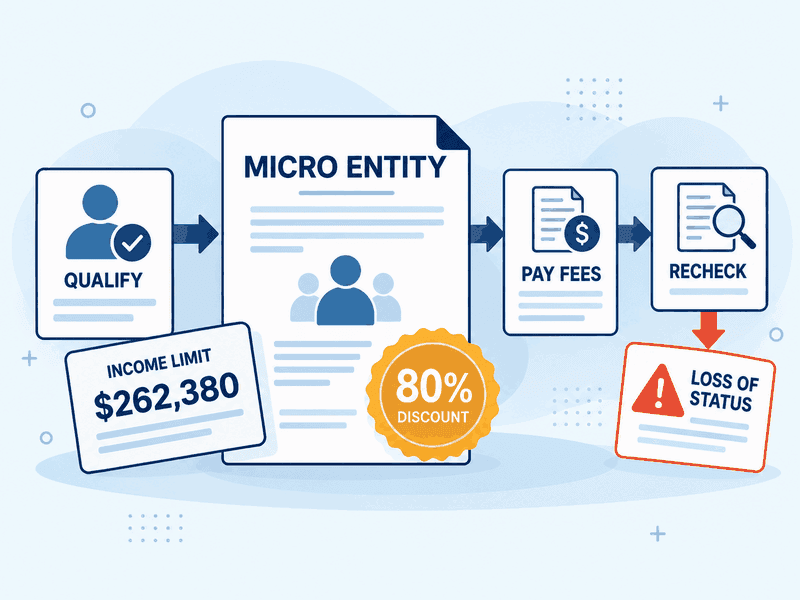
Patent applicants who qualify for micro entity status can receive an 80% reduction on most United States Patent and Trademark Office (USPTO) fees. However, the micro entity status USPTO requirements involve more than being an independent inventor or operating a small business.
As of September 15, 2026, the maximum qualifying gross income under the USPTO’s gross income basis is $262,380. Applicants must also satisfy the applicable ownership, small entity, and certification requirements.
Eligibility can change after an application is filed. A patent owner who qualifies initially may lose that status because of income changes, ownership transfers, or licensing arrangements.
This guide explains who qualifies under 37 CFR 1.29, the two certification routes, how to claim the discount, and what happens when eligibility is lost.
Key Takeaways
- Micro entity status provides an 80% discount on most USPTO patent fees for qualifying applicants.
- The 2026 gross income limit is $262,380, effective September 15, 2026, under the gross income basis.
- Every applicant, inventor, and other party with an ownership interest must qualify as a small entity. Eligibility cannot be determined solely from the person submitting the application.
- There are two certification routes: the gross income basis using USPTO Form SB/15A and the institution of higher education basis using Form SB/15B.
- Eligibility must be reassessed whenever a fee is paid at the micro entity rate, although the certification does not need to be resubmitted with every payment.
- Losing eligibility requires action. The applicant must notify the USPTO using Form SB/460 and pay subsequent applicable fees at the correct rate.
What Are the Micro Entity Status USPTO Requirements?

Micro entity status is a reduced-fee classification established under 37 CFR 1.29. It allows eligible patent applicants and patent owners to pay qualifying USPTO fees at a discounted rate.
The USPTO describes the micro entity discount as an 80% reduction on most fees. This can significantly reduce government filing and prosecution expenses, particularly for independent inventors and early-stage businesses.
However, micro entity status is not automatically available to every small company or individual applicant.
Three fundamental requirements must be satisfied:
- Every applicant, inventor, and other party holding an ownership interest must qualify as a small entity.
- The applicable requirements of either the gross income basis or the institution of higher education basis must be satisfied.
- A proper micro entity certification must be filed in the application or patent.
The legal framework appears in 37 CFR 1.29, while the underlying small entity rules are established under 37 CFR 1.27.
Micro entity eligibility at a glance
| Requirement | What applicants need to know |
|---|---|
| Small entity status | Every applicant, inventor, and other owner must satisfy the applicable small entity requirements. |
| Qualifying basis | Meet either the gross income basis or the institution of higher education basis. |
| 2026 income limit | $262,380, effective September 15, 2026, for the gross income basis. |
| Certification | Submit USPTO Form SB/15A or SB/15B, depending on the qualifying basis. |
| Continuing eligibility | Reassess qualification whenever paying a fee at the micro entity rate. |
| Loss of status | Submit USPTO Form SB/460 and pay fees at the appropriate higher rate. |
An important distinction exists between qualifying for the discount and properly claiming it.
Even if an applicant meets the financial and ownership requirements, the required certification must be submitted before paying at the micro entity rate.
Likewise, having a certification on file does not guarantee continuing eligibility if circumstances change.
How Do You Qualify for Micro Entity Status?
There are two ways to qualify for micro entity status under 37 CFR 1.29: the gross income basis and the institution of higher education basis.
The gross income basis generally applies to qualifying independent inventors and small businesses. The institution of higher education basis addresses certain applicants and inventions connected to qualifying educational institutions.
Both routes require compliance with the underlying small entity requirement.
1. Gross income basis
The gross income basis is commonly used by individual inventors and startups seeking reduced USPTO fees.
Applicants must satisfy the applicable requirements of 37 CFR 1.29, including restrictions involving previous patent applications, gross income, and certain ownership or rights-transfer arrangements.
One important requirement concerns previous patent filings.
Under the gross income basis, an inventor generally must not have been named as an inventor on more than four previously filed patent applications, subject to exclusions specified in the regulation.
This means someone can satisfy the income requirement but still be ineligible because of their prior application history.
The financial requirements also extend beyond the person filing the application. Relevant applicants, inventors, and parties whose rights affect eligibility must be considered.
For example, if two inventors jointly own an application and one exceeds the applicable income threshold, the other inventor’s lower income does not independently establish micro entity eligibility.
Applicants must also examine whether relevant rights have been assigned, licensed, or become subject to obligations involving another entity.
The appropriate certification for this route is USPTO Form SB/15A.
2. Institution of higher education basis
The institution of higher education basis provides another qualification route for certain patent applications connected to qualifying educational institutions.
This route addresses circumstances involving eligible institutions or applicants with specified employment and assignment relationships to those institutions.
However, working at a university or developing an invention during academic research does not automatically establish eligibility.
The applicant must satisfy the relevant requirements under 37 CFR 1.29.
For example, a university researcher should examine the institution’s relationship to the invention and any applicable assignment obligations before claiming this status.
The appropriate certification is USPTO Form SB/15B.
Unlike the gross income basis, this route relies on the qualifying higher education relationship rather than the gross income basis requirements.
Applicants should identify the correct basis before completing their certification.
What Is the Micro Entity Gross Income Limit in 2026?

The micro entity gross income limit for 2026 is $262,380, effective September 15, 2026.
The USPTO states:
As of September 15, 2026, the maximum qualifying gross income for purposes of paying any eligible fee at the micro entity discount rate under the gross income basis has changed to $262,380.
This amount appears on the official USPTO micro entity status page.
The figure is based on a Census Bureau report. The USPTO updates the threshold approximately annually, generally in September or October.
Applicants should therefore check the applicable threshold when preparing a fee payment rather than assuming that an earlier amount remains current.
Does the income limit apply only to the inventor?
No. Qualification under the gross income basis is not determined solely by one inventor’s earnings.
The relevant applicants, inventors, and parties whose ownership interests or rights affect eligibility must be considered under the regulation.
For a patent application involving multiple inventors, this may require gathering information from more than one person.
A startup might have a founder whose income is below the published threshold but another co-inventor who does not meet the applicable requirements.
In that situation, the founder’s qualifying income does not override the other inventor’s circumstances.
Ownership and contractual arrangements can also affect eligibility, even when the person preparing the certification personally satisfies the financial requirements.
Does the income limit remain the same throughout the year?
Not necessarily.
The USPTO periodically adjusts the qualifying income threshold, meaning the amount applicable to one fee payment may differ from the amount applicable to a later payment.
The September 15, 2026 adjustment illustrates why applicants should check current USPTO guidance.
The income threshold is also only one component of eligibility. Meeting it does not eliminate the other requirements under the gross income basis.
What Is the Difference Between Small Entity and Micro Entity Status?
Understanding small entity vs micro entity USPTO classifications is important because the two categories have different requirements and discounts.
Small entity status is governed by 37 CFR 1.27. Micro entity status requires additional qualification under 37 CFR 1.29.
The USPTO generally provides a 60% reduction on many eligible fees for small entities and an 80% reduction on most eligible fees for micro entities.
| Classification | General discount | Main distinction |
|---|---|---|
| Undiscounted entity | No entity-based discount | Pays applicable undiscounted USPTO fees. |
| Small entity | 60% on many qualifying fees | Must satisfy 37 CFR 1.27. |
| Micro entity | 80% on most qualifying fees | Must satisfy the small entity requirement and additional requirements under 37 CFR 1.29. |
These distinctions can affect the overall cost of obtaining a patent.
A company may qualify as a small entity but fail to meet the additional micro entity requirements because of an inventor’s income or previous application history.
In that case, the company may still qualify for the small entity discount rather than paying undiscounted fees.
Why does patent ownership matter?
Patent inventorship and ownership are different legal concepts.
Inventorship identifies the individuals who contributed to the claimed invention. Ownership identifies the parties holding legal rights to the application or patent.
An inventor may initially own an invention but later assign patent rights to a business. A company may also obtain ownership through employment agreements or other arrangements.
These differences matter because micro entity eligibility depends on all relevant applicants, inventors, and owners.
Understanding patent inventorship versus ownership helps applicants identify who must be considered before certification.
Licensing arrangements can also affect eligibility. For example, granting or becoming obligated to grant certain patent rights to a large entity can remove small entity eligibility, which also prevents qualification as a micro entity.
The specific rights and agreements should be reviewed rather than assuming that every commercial relationship has the same effect.
How Do You File a Micro Entity Certification With the USPTO?
Applicants must submit the correct certification in the application or patent to establish micro entity status.
The USPTO provides separate forms for each qualification basis.
Form SB/15A: Gross income basis
USPTO Form SB/15A is used by applicants qualifying through the gross income basis.
Before completing the form, applicants should verify:
- Small entity eligibility for all relevant parties.
- Compliance with the applicable previous patent application limitation.
- Satisfaction of the gross income requirements.
- Ownership, assignment, and licensing arrangements that may affect eligibility.
The information should reflect the relevant parties’ actual circumstances, not simply those of the person preparing the certification.
For startups with multiple founders or inventors, coordinating this review before filing can help prevent incorrect claims.
Form SB/15B: Institution of higher education basis
USPTO Form SB/15B applies to applicants qualifying through the institution of higher education basis.
Applicants should verify that the relevant institution and their relationship to it satisfy the regulatory requirements.
University affiliation alone is not sufficient. The actual employment, ownership, and assignment circumstances must support the certification.
Who must sign the certification?
The certification must be signed by an authorized person under the applicable USPTO rules.
Effective July 20, 2026: applicants and patent owners domiciled outside the United States or its territories must be represented by a USPTO registered patent practitioner, and that practitioner must sign micro entity certifications and other papers requiring an authorized signature under 37 CFR 1.33(b).
This requirement affects international inventors, overseas startups, and foreign businesses pursuing US patents.
Foreign applicants should account for the representation and signature requirements when preparing their filings.
Must the certification be submitted with every payment?
No.
Once properly established, micro entity status remains in effect until changed. The certification does not need to be submitted again with every fee payment.
However, applicants must confirm continuing eligibility whenever paying a fee at the micro entity rate.
A certification remaining in the USPTO record does not mean the applicant can continue claiming the discount after losing eligibility.
When Must You Recheck Micro Entity Eligibility?
Micro entity eligibility must be reassessed every time a fee is paid at the discounted rate.
This applies even when the applicant previously submitted a valid certification.
Patent applications can remain pending for extended periods, and patent ownership or business circumstances can change before later payments become due.
Before paying application fees
An applicant may qualify when initially filing a patent application but experience a relevant change before a later fee is due.
For example, an inventor’s income may increase, or ownership of the application may change.
The applicant should reassess eligibility before making another micro entity payment.
This review applies throughout relevant stages of patent prosecution.
Before paying patent maintenance fees
Patent owners should also reassess their classification before paying maintenance fees at the micro entity rate.
An inventor who qualified during the application process may no longer meet the requirements years after the patent issues.
Business expansion, ownership transfers, and licensing agreements can affect the applicable classification.
Including an eligibility review in patent maintenance fee planning helps ensure the correct rate is paid.
The review should occur before the payment is submitted.
After ownership or licensing changes
Assignments and licensing arrangements are particularly important because they may affect the underlying small entity requirement.
A business that initially owns its patent independently may later grant rights to a larger company.
Depending on the agreement, those rights can affect eligibility for reduced USPTO fees.
Inventors considering licensing a patent should evaluate these consequences before future payments.
Not every agreement automatically causes a loss of status. The relevant ownership interests, rights, and regulatory requirements determine the outcome.
What Happens If You Lose Micro Entity Status?

An applicant or patent owner who no longer qualifies must notify the USPTO and pay subsequent applicable fees at the correct rate.
The USPTO provides Form SB/460, titled Notification of Loss of Entitlement to Micro Entity Status, for this purpose.
Losing micro entity status does not necessarily eliminate every available discount.
If the applicant still satisfies the small entity requirements, eligible fees may be paid at the small entity rate. Otherwise, the undiscounted rate applies.
Common situations that can cause a loss of status
Several developments should trigger an eligibility review.
Income changes: A relevant inventor, applicant, or other party may no longer satisfy the gross income requirements.
Ownership transfers: Assigning patent rights may introduce an owner whose circumstances affect eligibility.
Licensing arrangements: Granting or becoming obligated to grant rights to an entity that does not qualify as a small entity may affect the applicant’s classification.
Changes in applicant structure: A change involving applicants, inventors, or other parties with ownership interests may require reassessment.
Changes affecting the certification basis: Circumstances supporting the original certification may no longer apply.
These situations do not always produce automatic disqualification. Their effects depend on the applicable regulation and the specific circumstances.
For instance, an independent inventor who initially qualifies may later assign patent rights to a larger business. The assignment can change the applicable entity classification, even though the inventor’s own income remains below the threshold.
[NEEDS REAL EXAMPLE FROM JONAS]
How do you notify the USPTO?
When an application or patent no longer qualifies, the applicant or owner must submit the notification of loss of entitlement using USPTO Form SB/460.
Subsequent applicable fees must be paid at the correct small entity or undiscounted rate.
Applicants should not continue paying micro entity fees merely because the original certification remains on file.
If earlier payments were also made incorrectly, the applicant must separately consider the applicable correction procedures.
What If Micro Entity Status Was Claimed Incorrectly?
An incorrect micro entity claim may require correction and payment of previously underpaid fees.
Some errors arise despite a good-faith attempt to establish eligibility. Others involve an applicant who qualified initially but failed to notify the USPTO after losing entitlement.
37 CFR 1.29(k) provides procedures for addressing certain errors.
Under 37 CFR 1.29(k)(1), an error can be excused upon compliance with the separate submission and itemization requirements.
Under 37 CFR 1.29(k)(2), the applicable fee deficiency must be paid.
These procedures are also discussed in MPEP 509.04(f).
An applicant should not assume that changing entity status for future payments automatically resolves earlier underpayments.
The relevant fee history should be reviewed to identify whether corrections and deficiency payments are necessary.
Can an incorrect claim affect a patent?
An improper micro entity claim may require correction and payment of deficiencies under 37 CFR 1.29(k).
Serious or repeated errors can also raise patent enforceability questions, depending on the circumstances.
However, an incorrect certification does not automatically establish a particular enforceability outcome.
Applicants who discover an error should consult a registered patent practitioner to determine the appropriate correction process and assess any broader legal implications.
[ATTORNEY REVIEW NEEDED: improper claim consequences section]
How Can Inventors and Startups Avoid Micro Entity Status Problems?
The most practical way to reduce errors is to make entity-status verification part of routine patent administration.
Independent inventors should review their qualifying circumstances before certification. Startups may need to coordinate information among inventors, founders, patent owners, and legal counsel.
A consistent review process can help identify changes before incorrect payments occur.
Keep an accurate record of relevant parties
Maintain current information about applicants, inventors, owners, and relevant agreements affecting patent rights.
A certification based on outdated ownership information can cause problems even when the person preparing it believes the application qualifies.
Review assignment and licensing documents whenever ownership arrangements change.
Check the current USPTO income threshold
Applicants using the gross income basis should confirm the applicable USPTO threshold before a discounted payment.
The amount used when an application was initially filed may not remain current.
The September 15, 2026 adjustment demonstrates why relying on an old threshold can create unnecessary risk.
Review patent filing history before certification
The gross income basis includes restrictions involving previously filed patent applications.
Applicants should review their relevant filing histories under 37 CFR 1.29 rather than estimate the number of previous inventions or issued patents.
The number of inventions developed is not necessarily the same as the number of applications counted under the regulation.
Build eligibility checks into fee approvals
Startups and small businesses can establish a short internal review before authorizing USPTO payments.
A practical review should answer three questions:
- Does the applicant still qualify under the previously certified basis?
- Have any relevant income, ownership, or rights-related circumstances changed?
- Does the proposed payment reflect the correct entity classification?
Documenting these checks can help maintain consistency when different employees or outside providers handle patent administration.
Reassess after major business transactions
Patent assignments, licensing agreements, and financing arrangements involving patent rights should trigger consideration of entity-status consequences.
The goal is not to assume every transaction eliminates eligibility. It is to identify changes that may affect qualification before the next fee payment.
For businesses managing multiple patents, incorporating this review into normal transaction and fee-management procedures can reduce avoidable mistakes.
Conclusion
Micro entity status can substantially reduce USPTO patent fees, but qualifying requires more than staying below an income threshold.
Under 37 CFR 1.29, applicants must satisfy the small entity requirement, qualify under one of the two permitted bases, and submit the appropriate certification.
For the gross income basis, the maximum qualifying income is $262,380 as of September 15, 2026.
The most important practical rule is to confirm eligibility before every payment made at the micro entity rate.
Keeping ownership records current, monitoring relevant changes, and using the correct notification procedures can help inventors and businesses avoid improper claims and unnecessary fee corrections.
Frequently Asked Questions
1. What are the micro entity status USPTO requirements?
Applicants must qualify as small entities, satisfy either the gross income or institution of higher education basis, and file the appropriate certification. The requirements are governed by 37 CFR 1.29, with small entity status addressed under 37 CFR 1.27.
2. What is the micro entity gross income limit in 2026?
The maximum qualifying gross income is $262,380, effective September 15, 2026. The USPTO periodically updates this amount, so applicants should verify the current threshold before making discounted fee payments.
3. Can a startup qualify for micro entity status?
Yes. A startup may qualify if its relevant applicants, inventors, and owners meet the small entity requirement and the applicable additional micro entity conditions. Being a newly established business does not automatically establish eligibility.
4. What is the difference between USPTO Forms SB/15A and SB/15B?
USPTO Form SB/15A certifies eligibility under the gross income basis. Form SB/15B applies to the institution of higher education basis. Applicants must select the form matching their qualifying circumstances.
5. Do I need to recertify micro entity status every year?
No. A properly established certification remains effective until changed and does not need annual resubmission. However, eligibility must be reassessed whenever a fee is paid at the micro entity rate.
6. What happens if I lose micro entity status after filing?
You must notify the USPTO using Form SB/460 and pay subsequent applicable fees at the appropriate rate. If you remain eligible for small entity status, that discount may still be available.
7. Can I correct an incorrect micro entity certification?
Certain good-faith errors and failures to report loss of entitlement through error may be excused under 37 CFR 1.29(k). Correction involves the applicable separate submission and itemization requirements, together with payment of the deficiency, as explained in MPEP 509.04(f).