
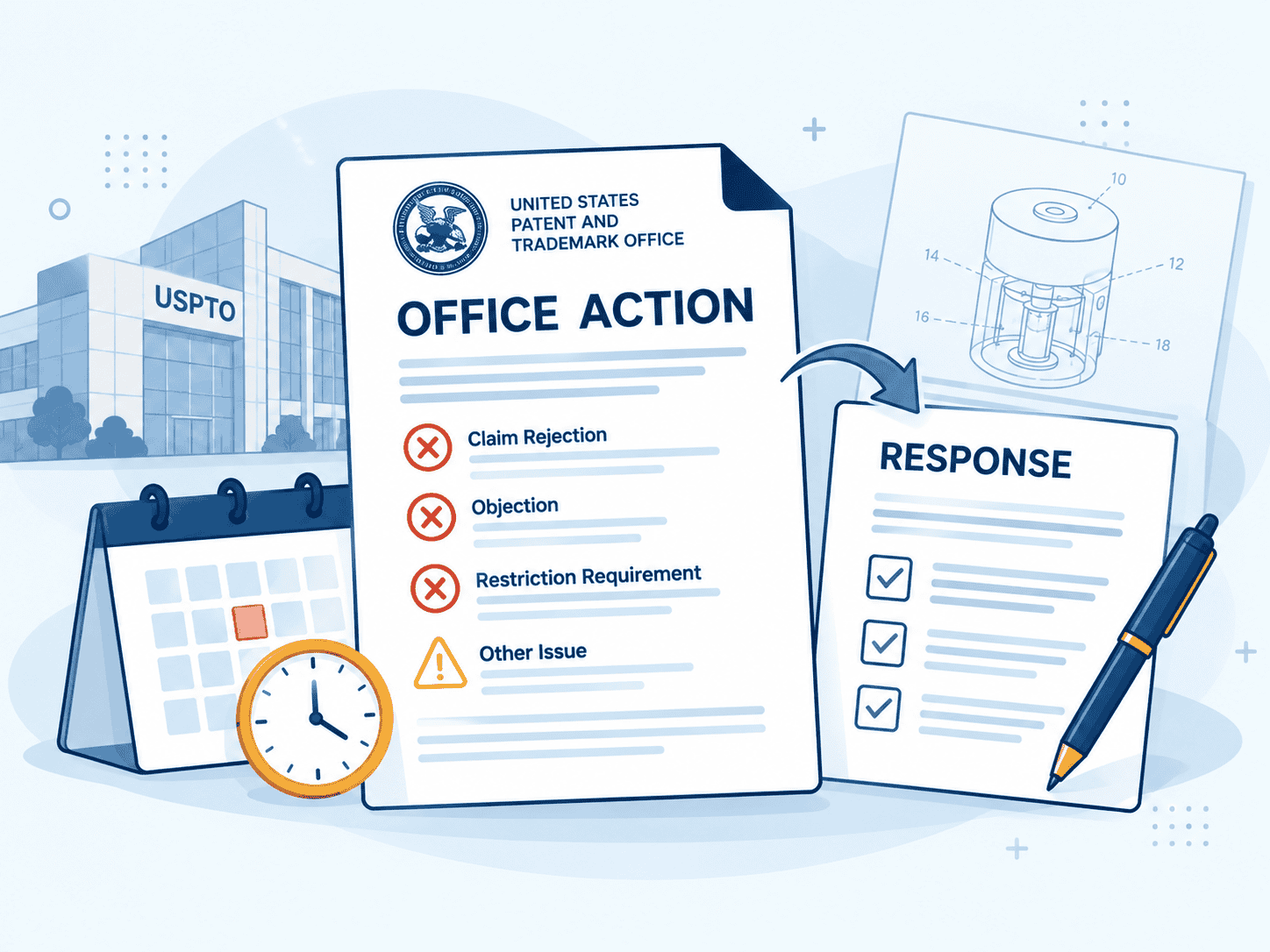
Receiving a USPTO office action can be unsettling, especially when the letter includes several patent claim rejections and a deadline to respond. But an Office Action doesn’t automatically mean your invention cannot be patented. It means the United States Patent and Trademark Office (USPTO) has identified issues that need to be addressed before examination can move forward.
For inventors, startups, and businesses, understanding the examiner’s objections is only part of the process. You also need to know which deadlines apply, whether to amend your patent claims, and how your response could affect the protection your patent eventually provides.
This guide explains what an Office Action is, the different types, common rejection grounds, and how to prepare a response that addresses the examiner’s concerns without unnecessarily limiting your invention.
This article focuses on U.S. patent applications, not trademark Office Actions. It provides general educational information and is not legal advice for a particular application.
Key Takeaways
- A USPTO Office Action is an official examiner communication identifying issues that must be addressed for patent examination to continue.
- Non-final and final Office Actions create different response opportunities. A final rejection doesn’t necessarily end the application.
- Most patent Office Actions have a shortened response period of two or three months, while the statutory maximum is generally six months.
- A proper response to Office Action rejections may involve legal arguments, claim amendments, supporting evidence, or examiner interviews.
- The strongest response addresses every outstanding issue while preserving commercially meaningful patent protection.
What Is a USPTO Office Action?
A USPTO Office Action is a formal written communication issued by a patent examiner during the examination of a patent application.
After reviewing an application, the examiner determines whether the claimed invention meets applicable patentability requirements. If the examiner identifies problems, the USPTO may issue an Office Action explaining those problems and requiring an appropriate response.
The communication may address substantive legal issues, technical distinctions between the invention and existing technology, or formal requirements involving the application’s claims, drawings, and description.
An Office Action is part of a process known as patent prosecution, which involves communication between the applicant and the USPTO as the application is examined.
Why does the USPTO issue Office Actions?
Patent examiners evaluate applications against legal requirements established under U.S. patent law. Their work includes reviewing the claims, searching for relevant prior art, and determining whether the invention satisfies requirements such as novelty, nonobviousness, and adequate disclosure.
An examiner might identify an earlier patent describing a similar invention, conclude that a claimed feature would have been obvious, or determine that the application does not explain a particular aspect clearly enough.
For example, imagine an inventor files a patent application for a smart irrigation controller that automatically adjusts watering based on soil conditions.
During examination, the examiner identifies an earlier patent describing a controller that uses soil moisture measurements. The examiner may reject certain claims based on that reference.
The inventor must then evaluate whether the earlier technology actually contains the features claimed in the application.

If the new controller uses a particular calibration method or combination of inputs not disclosed or rendered obvious by the prior art, the applicant may be able to explain that distinction through arguments or properly supported claim amendments.
The important point is that an Office Action is an opportunity to address the examiner’s findings, not necessarily a final refusal of patent protection.
The USPTO’s official guidance on responding to patent Office Actions explains the types of examiner correspondence and the general requirements for replying.
What kinds of patent issues appear in an Office Action?
An examiner can identify several different issues in the same communication.
| Issue | What it means | Potential response |
| 35 U.S.C. § 101 | The claims do not satisfy patent-eligibility requirements. | Explain why the claimed subject matter is eligible or amend the claims when appropriate. |
| 35 U.S.C. § 102 | The examiner determines that prior art anticipates a claimed invention. | Identify claim limitations not disclosed by the cited reference. |
| 35 U.S.C. § 103 | The examiner considers the claimed invention obvious in view of prior art. | Challenge the examiner’s reasoning or make supported amendments. |
| 35 U.S.C. § 112 | The examiner identifies problems involving claim clarity, written description, or enablement. | Clarify language, identify disclosure support, or address the specific deficiency. |
| Formal objection | A drawing, claim, or other application material contains a correctable formal issue. | Correct the identified issue. |
| Restriction requirement | The examiner determines that the application claims multiple inventions requiring separate examination. | Elect an invention and evaluate whether additional applications are appropriate. |
These issues are not interchangeable. A formal objection may require a relatively straightforward correction, while an obviousness rejection can involve substantial analysis of patent claims and technical references.
Understanding precisely what the examiner is challenging helps determine the scope of the response.
If an application has not yet been submitted, careful patent application preparation can also reduce preventable claim clarity and disclosure problems during later examination.
Types of USPTO Office Actions
Not every Office Action represents the same stage of patent examination.
Two of the most important distinctions are between non-final and final actions. Applicants may also encounter restriction requirements and other examiner communications with different procedural implications.
Non-Final Office Action
A non-final Office Action typically presents the examiner’s initial substantive findings about the patent application’s claims.
It identifies the claims being rejected or objected to and explains the reasons.
The applicant generally has an opportunity to respond by presenting arguments, amending claims, correcting formal defects, or submitting permissible supporting evidence.
Consider an application for a medical monitoring device. The examiner rejects an independent claim under § 103, citing two earlier publications.
The applicant may respond by identifying why the cited references do not teach or suggest the claimed arrangement, explaining errors in the examiner’s combination of references, or amending a claim to include a supported technical distinction.
The examiner reviews the response and determines whether the remaining issues have been resolved.
If the response successfully addresses the rejections, the application may move toward allowance. Otherwise, the examiner may issue another Office Action.
Final Office Action
A final Office Action generally occurs after an applicant has already received and responded to an earlier substantive rejection, although finality must satisfy applicable USPTO rules.
The word final refers to a procedural stage in examination. It doesn’t necessarily mean that the applicant has exhausted every available option.
However, the applicant no longer has the same unrestricted opportunity to amend claims as before final rejection.
Depending on the application and issues involved, possible approaches include an eligible after-final amendment, a request for continued examination, an appeal, or appropriate continuing-application practice.
An applicant may also request an examiner interview to clarify whether certain amendments could resolve the rejection.
The central difference is that a final action requires more careful procedural planning because additional amendments are not automatically entered as a matter of right.
Non-Final vs. Final Office Action
| Feature | Non-Final Office Action | Final Office Action |
| Typical stage | Initial substantive examination response | Later examination stage |
| Claim amendments | Generally permitted subject to applicable rules | More restricted |
| Arguments against rejections | Permitted | Permitted, subject to after-final procedures |
| Examiner interviews | Often useful | Often useful |
| Request for continued examination | May be available when eligible | Common option when eligible |
| Appeal | Generally premature before an appealable rejection | May be available |
| Patent application automatically denied? | No | No |
Restriction Requirement
A restriction requirement occurs when an examiner determines that a single patent application contains claims directed to multiple inventions that should be examined separately.
For instance, an applicant might claim both a manufacturing machine and a distinct manufacturing process. Under the applicable rules, the examiner may require the applicant to elect one invention for examination.
The applicant may make the required election and, when appropriate, traverse the restriction by explaining why it is improper.
Claims to a nonelected invention may potentially be pursued through a divisional application, subject to applicable requirements.
A restriction requirement is different from a rejection under § 102 or § 103. It concerns the scope of examination rather than necessarily determining that the elected invention is unpatentable.
USPTO Office Action Deadlines and Extensions
One of the most important parts of handling a USPTO Office Action is identifying the correct response deadline.
Patent applicants should not assume that every examiner communication allows the same amount of time to respond.
For most patent Office Actions, the USPTO sets a shortened statutory period, commonly two or three months. In many circumstances, extensions are available for the required fee, but the maximum statutory response period is generally six months from the Office Action’s mailing date.
The deadline must be determined from the specific communication and applicable rules.

How long do you have to respond?
| Deadline element | General rule |
| Shortened statutory period | Commonly two or three months, depending on the action |
| Standard non-final substantive action | Often three months |
| Standard final substantive action | Often three months |
| Maximum statutory response period | Generally six months from the mailing date |
| Extension fees | May apply when responding after the shortened period |
| Failure to respond | May result in abandonment of the application |
These are general rules for patent applications. Specific communications and proceedings can have different requirements, and extensions are not universally available.
The USPTO’s Manual of Patent Examining Procedure, Section 710, explains how response periods are calculated and administered.
Example: Calculating an Office Action deadline
Suppose the USPTO mails a non-final Office Action on March 10 and establishes a three-month shortened statutory period.
The standard deadline would ordinarily be June 10.
If the applicant qualifies for extensions under the applicable rules, an extended filing period may be available up to September 10, subject to the required fees.
The critical distinction is that the extension period is not automatically a free additional three months.
An applicant who files after the shortened deadline must satisfy the applicable extension requirements.
Deadlines also require attention to weekends, federal holidays, USPTO filing rules, and any special instructions in the communication.
What happens if you miss the deadline?
Failure to submit a timely and acceptable response can cause a patent application to become abandoned.
Abandonment generally means the application is no longer pending and will not continue through ordinary examination unless appropriate relief is granted.
In some circumstances, an applicant may petition to revive an unintentionally abandoned application, but revival requires satisfying the applicable legal requirements and paying relevant fees.
Revival should not be treated as a guaranteed safety net.
Missing a response deadline can also create additional expenses, delay the patent process, and complicate an applicant’s broader intellectual-property strategy.
For businesses developing products around pending applications, these consequences can affect investment planning, licensing discussions, and decisions about public disclosure.
A reliable deadline-management process should record the USPTO mailing date, the shortened response period, the maximum applicable deadline, and internal drafting and review dates.
Why early responses can matter after final rejection
A final Office Action may include special provisions concerning an initial after-final response filed within two months.
Under certain conditions, if the applicant files an initial reply within two months and the USPTO mails an advisory action after the three-month shortened period, the advisory-action mailing date can affect the calculation of extension fees.
This procedure does not extend the statutory maximum beyond six months.
It also doesn’t mean that any after-final amendment automatically qualifies as a sufficient response.
The applicable rules distinguish between submitting a proposed amendment and taking action that satisfies the final-response requirements.
Applicants should review the specific final Office Action and the USPTO’s MPEP Section 714 on amendments and applicant responses before relying on an after-final filing strategy.
How to Prepare an Office Action Response
A successful office action response requires more than explaining why the applicant believes the invention is patentable.
The response must address the examiner’s specific findings, follow USPTO procedural requirements, and preserve the scope of the invention wherever reasonable.
The process is particularly important when the application includes commercially valuable features that competitors might attempt to reproduce.
1. Read the Office Action and identify every issue
Begin by reviewing the entire document, including the summary, claim status, statutory rejections, objections, and cited references.
The examiner may reject some claims while indicating that others contain allowable subject matter.
These distinctions can influence the strategy.
For example, an application may contain 15 claims. The examiner might reject claims 1–10 under § 103, object to claims 11–13, and indicate that claims 14–15 would be allowable if rewritten in independent form.

Treating all 15 claims as equally problematic would overlook potentially useful information.
A practical first step is to prepare an issue-by-issue analysis.
| Item | What to record |
| Claim number | Which claims are affected |
| USPTO finding | Rejection, objection, or other requirement |
| Legal basis | Applicable patent statute or rule |
| Examiner’s evidence | Cited patent, publication, or specification passage |
| Response approach | Argument, amendment, correction, or other permitted action |
This provides a clear foundation for drafting the reply.
2. Analyze the cited prior art
For rejections based on novelty or obviousness, carefully examine the references cited by the examiner.
Don’t rely only on the examiner’s summary.
Read the relevant passages, figures, and claim language to understand exactly what the earlier technology discloses.
Consider a patent application claiming a sensor system that automatically recalibrates during operation.
The examiner cites a prior patent describing a sensor with factory calibration.
At first glance, the two technologies appear similar because both involve calibrated sensors. But factory calibration and continuous recalibration during operation are not necessarily the same technical process.
A meaningful response would examine whether the cited reference teaches the particular recalibration requirement, whether another reference supplies that feature, and whether the examiner has provided adequate reasoning for any proposed combination.
The applicant should focus on the limitations actually recited in the claims.
A distinction involving an interesting feature that isn’t claimed may have limited value in overcoming the rejection.
For particularly complex rejections, a patent search or patentability opinion may provide additional context about the relevant prior art and the strength of the applicant’s position.
3. Decide whether to amend the claims or present arguments
An office action response may include arguments, claim amendments, or both.
Arguments are often appropriate when the examiner has overlooked a claim limitation, misunderstood a technical reference, or applied an unsupported interpretation.
Amendments may be appropriate when a narrower claim can distinguish the invention from prior art while retaining valuable protection.
However, narrowing a patent claim has consequences.
Suppose an inventor develops a smart lock that uses a combination of biometric authentication and a particular encrypted communication process.
The examiner rejects a broad claim covering biometric authentication systems.
The applicant could narrow the claim by adding several technical details from the preferred product.
That might resolve the rejection, but it could also create a patent that competitors avoid by changing one unnecessary feature.
A better approach is to determine which limitations are needed to distinguish the invention and whether those limitations meaningfully protect the business’s product or technology.
The objective isn’t simply to obtain allowance. It’s to pursue claims that remain useful after the patent issues.
4. Confirm that every amendment has support
Patent applicants generally cannot introduce new matter into an existing application through a claim amendment.
Any newly added limitation must have adequate support in the originally filed disclosure.
For example, suppose an applicant wants to amend a claim to require a particular temperature-control sequence.
Before making the amendment, the applicant should identify where that sequence is supported in the original specification, drawings, or claims.
If the original application only describes a general temperature-control system, introducing a specific undisclosed sequence may create a written-description or new-matter problem.
This is why careful claim drafting and detailed technical disclosures matter from the beginning of the patent process.
A response that fixes one rejection by introducing unsupported subject matter may generate additional problems.
5. Prepare a complete written response
A response to Office Action rejections must address the outstanding issues according to the applicable USPTO rules.
In a typical substantive response, the applicant may need to include amended claims in the required format, remarks identifying the rejections being contested, arguments supporting patentability, and any appropriate evidence.
The response should explain how the applicant has addressed each rejection or objection rather than making broad statements that the invention is different from the prior art.
For example, a statement such as:
“The cited patent does not disclose the applicant’s invention.”
provides little useful explanation.
A more meaningful response identifies a particular claim limitation, explains what the examiner cited, and demonstrates why the reference does not disclose that limitation or why the examiner’s obviousness rationale is insufficient.
The written record is important because statements made during prosecution may later affect how the patent’s claims are interpreted.
Consistency, accuracy, and deliberate claim language matter throughout the process.
6. Consider an examiner interview
An examiner interview can help clarify technical disagreements, discuss proposed claim amendments, or determine whether a particular approach could resolve an outstanding rejection.
These discussions can be especially valuable when the examiner appears to misunderstand a technical distinction or when relatively limited amendments might place the claims in condition for allowance.
However, an interview does not automatically resolve an Office Action, and it does not replace a required written response.
Any agreements, proposed amendments, and remaining issues must be handled through the appropriate USPTO procedures.
Applicants facing difficult rejections can also seek assistance from a patent attorney experienced in responding to the USPTO.
A registered patent practitioner can help evaluate the examiner’s reasoning, prepare compliant responses, and determine whether proposed amendments preserve meaningful protection.
7. File the response and verify submission
Once the response is complete, confirm the filing deadline, required signature, claim-amendment formatting, and any applicable extension fees.
Patent application correspondence is generally submitted through the USPTO’s electronic filing system using the appropriate filing procedures.
After submission, retain the filing acknowledgment and confirm that the correspondence has been properly recorded.
Filing an incomplete or procedurally deficient response may create additional complications. In particular, applicants should not assume that submitting any document before the deadline will necessarily prevent abandonment.
A final quality review should confirm that every outstanding issue has been addressed and that the submission satisfies the requirements applicable to that Office Action.
What Happens After an Office Action Response?
After receiving an appropriate response, the examiner reviews the applicant’s arguments, amendments, and supporting materials.
The next step depends on whether the response resolves the outstanding issues.
Some applications move toward allowance, while others require additional examination or procedural action.

The examiner allows the claims
If the examiner determines that the pending claims satisfy the applicable patentability requirements, the USPTO may issue a Notice of Allowance.
The applicant must then satisfy any remaining requirements, including payment of the issue fee, before the patent can issue.
A Notice of Allowance is a positive development, but it is not the same as an issued patent.
The examiner issues another Office Action
If the examiner continues to disagree with the applicant, another Office Action may follow.
Depending on the examination history and applicable finality rules, that communication may be non-final or final.
The applicant must review the new findings rather than assuming that earlier arguments remain sufficient.
A subsequent Office Action may maintain previous rejections, introduce new grounds where permitted, or identify additional issues arising from claim amendments.
Each communication should be evaluated on its own terms, including its response deadline.
The applicant considers continued examination or appeal
When an application reaches final rejection, the applicant may need to decide whether further prosecution or formal review is appropriate.
For eligible applications, a request for continued examination (RCE) can reopen prosecution upon satisfaction of the applicable requirements and fees.
An appeal to the Patent Trial and Appeal Board may be appropriate when the applicant believes the examiner’s rejection is legally or factually incorrect and the appeal requirements are satisfied.
In appropriate circumstances, a continuation application may also allow an applicant to pursue different claims supported by the original disclosure.
These options have different costs, timing implications, and procedural requirements. In particular, RCE practice is not available for design patent applications.
Selecting between them depends on the examination history, the legal issues involved, the technology, and the applicant’s commercial objectives.
Why the outcome matters beyond patent approval
The quality of an office action response may influence more than whether an application is ultimately allowed.
Amendments and arguments can shape the scope of the issued claims and the prosecution history used to interpret them.
For a startup, narrowly drafted claims may provide less competitive protection than expected.
For an established business, claim limitations may affect licensing negotiations, product coverage, and future infringement analysis.
This is why resolving an examiner’s rejection should not be treated as an isolated paperwork exercise.
The response should address the immediate legal issues while considering the invention’s longer-term commercial value.
Conclusion
A USPTO Office Action is an important stage of patent examination, not an automatic end to the application.
The most effective approach begins with identifying the correct deadline and understanding every rejection or objection. From there, applicants should carefully assess the prior art, determine whether arguments or amendments are appropriate, and ensure that each response preserves meaningful protection where possible.
An Office Action may present obstacles, but a well-prepared response can help advance the application while protecting the invention’s long-term value.
FAQs
What is an Office Action from the USPTO?
An Office Action is an official written communication from a USPTO patent examiner identifying issues with a pending patent application. It may contain patent claim rejections, formal objections, restriction requirements, or other matters requiring an applicant’s response. Receiving one does not automatically mean the application has been denied.
How long do I have to respond to a USPTO Office Action?
Many patent Office Actions set a shortened response period of two or three months. Extensions may be available under applicable rules, generally subject to fees, but most patent Office Actions have a statutory maximum response period of six months. Always check the specific communication to determine the correct deadline.
What is the difference between a final and non-final Office Action?
A non-final Office Action generally provides an opportunity to respond to initial substantive rejections through arguments or amendments. A final Office Action places the application at a later procedural stage where amendments are more restricted. Applicants may still have options such as an eligible after-final amendment, continued examination, or appeal.
Can I respond to an Office Action without a patent attorney?
Individuals may represent themselves in prosecuting their own patent applications before the USPTO, subject to applicable rules. However, Office Action responses frequently involve technical claim interpretation, prior art analysis, and patent law. Working with a registered patent attorney or patent agent can help applicants avoid unsupported amendments and unnecessary restrictions on claim scope.
How much does an Office Action response cost?
The cost depends on the complexity of the rejections, the number of affected claims, the prior art involved, and the work needed to prepare arguments or amendments. Attorney or patent-agent fees may be the primary expense for a straightforward response, while extension fees, RCE fees, or appeal-related costs can increase the total. A substantive Office Action response does not generally require a separate USPTO response fee merely to file it within the normal response period.
What happens if my Office Action response is rejected?
If the examiner remains unpersuaded, the USPTO may issue another Office Action or maintain the rejection through the appropriate examination procedures. Depending on the application’s status, the applicant may consider further amendments, continued examination, an examiner interview, or appeal. A rejected argument does not necessarily mean that all available prosecution options have been exhausted.
Can a patent application be revived after missing an Office Action deadline?
In some circumstances, the USPTO may permit revival of an application abandoned because of an unintentionally delayed response. Revival generally requires a petition, applicable fees, and satisfaction of the relevant requirements. Because revival is not automatic, applicants should treat every Office Action deadline as a critical filing requirement.