
A missed USPTO deadline can cause a patent application to become abandoned, potentially interrupting years of work and investment. Fortunately, filing a petition to revive abandoned patent application may allow an applicant to resume prosecution when the entire delay in taking the required action was unintentional.
Under 37 CFR 1.137, the United States Patent and Trademark Office (USPTO) provides a procedure for reviving certain abandoned applications. Applicants generally must complete the missed action, pay the applicable petition fee, and submit an unintentional-delay statement.
An important rule change took effect on August 13, 2026. Petitions filed more than one year after the applicable deadline now require additional explanation and a higher petition fee. Previously, those requirements generally applied after two years.
This guide explains when revival is possible, what it costs, how to file a petition, and how the updated one-year rule affects applicants.
Key Takeaways
- Abandoned applications may be revived. Under 37 CFR 1.137, applicants may request revival when the entire delay was unintentional.
- The one-year threshold has changed. Since August 13, 2026, petitions filed more than one year after the applicable deadline require additional explanation and a higher fee.
- USPTO revival petition fees range from $452 to $3,000. The amount depends on entity status and the length of the delay.
- The missed action must generally be completed. Applicants must ordinarily submit the overdue Office Action response or issue fee.
- Additional documents may be required. Form PTO/SB/64, an unintentional-delay statement, and, for certain applications, a terminal disclaimer are relevant to the petition.
- Abandonment differs from patent expiration. Reviving an abandoned application is not the same as reinstating an issued patent that expired because of unpaid maintenance fees.
What Does It Mean When a Patent Application Is Abandoned?

A patent application becomes abandoned when an applicant fails to satisfy certain procedural requirements within the time allowed by the USPTO.
Abandonment generally ends active examination. The application will not continue through ordinary prosecution unless the abandonment is overcome through an available legal procedure.
For inventors and businesses, this can interrupt a patent strategy, particularly when the application concerns a product being developed, manufactured, or prepared for commercialization.
Two common causes are missed Office Action responses and unpaid issue fees.
Missing an Office Action Response Deadline
During examination, the USPTO may issue an Office Action identifying claim rejections, objections, or other matters requiring a response.
The applicant must respond within the applicable period, including any properly available extensions. Failure to submit a timely and sufficient response can result in abandonment.
For example, an examiner may reject claims because the invention appears obvious in view of earlier technology. The applicant may need to amend the claims or explain why the rejection is incorrect.
If the applicant misses the response deadline, the application may become abandoned even though substantive arguments supporting patentability remain available.
Understanding the requirements for responding to a USPTO Office Action helps applicants recognize which communications require action and when a response must be filed.
Importantly, procedural abandonment does not necessarily mean that the USPTO determined the invention was unpatentable.
Missing the Patent Issue Fee Deadline
Abandonment can also occur after an application receives a Notice of Allowance.
The Notice of Allowance means the application has reached the allowance stage, but the patent has not yet issued. The applicant generally must pay the issue fee within three months.
This statutory payment period ordinarily cannot be extended.
If the issue fee is not paid, the application may become abandoned. When the failure was unintentional, the applicant may request revival by submitting the required payment and satisfying 37 CFR 1.137.
How Is an Abandoned Application Different From a Lapsed Patent?
Abandoned applications and lapsed patents involve different legal statuses and procedures.
| Issue | Abandoned Patent Application | Lapsed Patent |
|---|---|---|
| Status | Application has not matured into an issued patent | Patent was previously issued |
| Common cause | Missed Office Action response or issue fee | Missed maintenance fee |
| Applicable regulation | 37 CFR 1.137 | 37 CFR 1.378 |
| Main objective | Resume prosecution or complete issuance | Reinstate an expired patent where permitted |
| Required payments | Revival petition fee and outstanding action or issue fee | Maintenance fee, surcharge, and applicable petition requirements |
Maintenance fees generally apply to issued utility patents, not pending applications. Design patents do not require periodic maintenance fees.
Applicants dealing with an issued patent that expired because of unpaid maintenance fees should review the separate procedures explained in our guide to patent maintenance fees.
Identifying whether the matter involves an abandoned application or an expired patent is essential before choosing a remedy.
Can an Abandoned Patent Application Be Revived?
Yes. An abandoned patent application may be revived when the applicant satisfies the requirements of 37 CFR 1.137 and establishes that the entire delay in taking the required action was unintentional.
Revival is not automatic. The USPTO must review the petition and determine whether the regulatory requirements have been satisfied.
What Does 37 CFR 1.137 Require?
Under 37 CFR 1.137, a petition for revival based on unintentional delay generally requires:
- The required reply to the outstanding USPTO action or notice, unless previously submitted or otherwise addressed under the rule.
- The applicable petition fee under 37 CFR 1.17(m).
- A statement that the entire delay in filing the required reply was unintentional.
- A terminal disclaimer and its associated fee when required.
- Additional information explaining the delay when the updated one-year threshold applies.
The specific documents depend on why the application became abandoned.
If the applicant missed an Office Action response, the overdue response ordinarily must accompany the petition. If abandonment resulted from nonpayment of the issue fee, that fee generally must be submitted.
The USPTO provides official instructions on its revival based on unintentional delay page.
Does Revival Guarantee That a Patent Will Be Granted?
No. Revival addresses the application’s procedural status, not whether the invention qualifies for a patent.
An examiner may still reject claims, require amendments, or raise additional issues during prosecution.
Likewise, an application revived after allowance must complete the remaining issuance requirements.
Applicants should distinguish between an active application and an enforceable patent. As explained in our guide to patent pending status, filing an application does not itself provide the same enforceable rights as an issued patent.
Revival allows the application process to continue. It does not guarantee patent approval or eliminate substantive examination requirements.
What Is the New One-Year Rule for Revival Petitions?
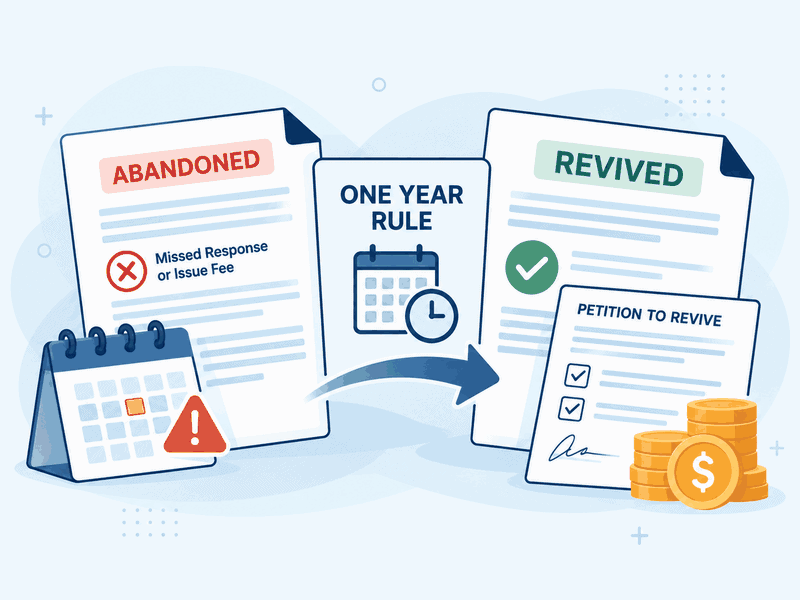
Effective August 13, 2026, the USPTO reduced the threshold for additional information and higher petition fees from more than two years to more than one year.
Applicants filing a revival petition after this threshold must explain why the entire delay was unintentional and pay the higher applicable fee.
The change was published in Federal Register document 2026-12717, Conditions for Additional Information and Fee in Petitions Filed in Patent Applications and Patents.
What Changed on August 13, 2026?
The rule changed when additional requirements apply, not the actual fee amounts.
| Requirement | Previous Rule | Rule Effective August 13, 2026 |
|---|---|---|
| Additional explanation threshold | More than 2 years | More than 1 year |
| Higher petition fee threshold | More than 2 years | More than 1 year |
| Unintentional-delay statement | Required | Required |
| Additional explanation after threshold | Required | Required |
| Petition fee amounts | Established fee schedule | Amounts unchanged |
Previously, an applicant filing after 18 months generally remained within the lower-fee threshold. Under the updated rule, that same delay triggers the higher fee and additional explanation requirement.
This makes early identification of abandonment particularly important.
Is There a One-Year Time Limit to Revive an Abandoned Patent Application?
The new one-year rule is not an absolute cutoff after which revival becomes impossible.
A petition may still be considered after one year, provided the applicant satisfies the additional requirements and establishes that the entire delay was unintentional.
However, longer delays may require a more detailed explanation of what occurred and why the applicant did not take the required action sooner.
The USPTO can request additional information when questions arise about the unintentional nature of the delay.
Applicants should therefore avoid treating revival as an open-ended opportunity to restart prosecution whenever convenient.
How Is the One-Year Period Calculated?
The relevant calculation generally begins with the applicable deadline for taking the missed action, accounting for any relevant extension or deadline adjustment.
For an Office Action, this means identifying the actual expiration of the response period. For an unpaid issue fee, the controlling date is the payment deadline.
Consider an application with an applicable response deadline of September 15, 2025.
A revival petition filed on September 15, 2026 would fall at the one-year threshold. A petition filed on September 16, 2026 would exceed one year.
That difference can determine whether the higher petition fee and additional explanation are required.
The date the applicant discovers the abandonment is not necessarily the controlling date.
Applicants should verify the official application history and calculate the delay from the applicable deadline rather than relying on when an abandonment notice was received.
How Much Does a Petition to Revive an Abandoned Patent Application Cost?

The petition to revive abandoned patent application fee depends on the applicant’s entity status and whether the delay exceeds one year.
The USPTO recognizes large, small, and micro entity categories. Eligible small and micro entities qualify for reduced fees.
USPTO Revival Petition Fees for 2026
Under the USPTO fee schedule effective January 19, 2025, and last revised August 14, 2026, the fees under 37 CFR 1.17(m) are:
| Entity Status | Delay of 1 Year or Less | Delay of More Than 1 Year |
|---|---|---|
| Large entity | $2,260 | $3,000 |
| Small entity | $904 | $1,200 |
| Micro entity | $452 | $600 |
These amounts are listed in the official USPTO patent fee schedule.
The August 2026 rule change did not increase these amounts. It reduced the delay threshold that determines when applicants must pay the higher fee.
Before submitting payment, applicants should confirm their eligibility for the claimed entity status.
What Additional Costs Should Applicants Expect?
The petition fee may represent only part of the total expense.
Other potential costs include:
- Outstanding issue fee: Required when abandonment resulted from nonpayment of the issue fee.
- Attorney fees: May cover reviewing the prosecution history, preparing the overdue response, drafting the petition, and addressing USPTO questions.
- Terminal disclaimer fee: Required for certain applications under 37 CFR 1.137(d).
- Further prosecution expenses: Additional responses, amendments, or proceedings may be necessary after revival.
Private attorney fees are separate from USPTO charges and depend on the work involved.
Applicants should obtain an itemized estimate distinguishing government fees, legal fees, and any anticipated prosecution expenses.
When Is a Terminal Disclaimer Required?
Under 37 CFR 1.137(d), a terminal disclaimer is required for:
- Utility and plant patent applications filed before June 8, 1995.
- All design patent applications, regardless of filing date.
The disclaimer must comply with the applicable requirements and be accompanied by the fee under 37 CFR 1.20(d).
The specified terminal disclaimer fee is $183.
A terminal disclaimer may affect the patent’s enforceable term, so applicants should understand its legal consequences before filing.
Utility and plant applications filed on or after June 8, 1995 generally do not require a terminal disclaimer solely because they are being revived under this provision.
How Do You File a Petition to Revive an Abandoned Patent Application?
To revive abandoned patent application USPTO records, applicants must establish the reason for abandonment, correct the missed action, and submit a compliant petition.
The following process addresses the principal filing requirements.
Step 1: Review the Official Application Record
Begin by checking the application’s status in USPTO Patent Center.
Review the filing history, outstanding communications, response deadlines, and abandonment information.
Determine which action was missed, when it was due, and whether any extensions applied.
This review helps establish the correct petition fee and whether the updated one-year rule requires additional explanation.
It also helps identify whether revival is the appropriate remedy.
Step 2: Prepare the Missing Response or Payment
Under 37 CFR 1.137, a revival petition generally must include the required reply unless it was previously submitted or another applicable provision addresses the requirement.
For an unanswered Office Action, this may involve claim amendments, patentability arguments, or other required corrections.
For an unpaid issue fee, the applicant generally must submit the outstanding payment.
Paying only the revival petition fee ordinarily will not correct the underlying abandonment.
The missed action must be addressed as part of a complete filing.
Step 3: Complete Form PTO/SB/64
Form PTO/SB/64, Petition for Revival of an Application for Patent Abandoned Unintentionally, is the USPTO form used to request revival based on unintentional delay.
It helps applicants provide the application information, petition request, required statements, and associated submissions.
The form is available through the USPTO’s official revival guidance.
Completing the form does not replace the need to meet every regulatory requirement. Applicants with delays exceeding one year must provide the additional explanation required under the updated rule.
Step 4: Prepare the Unintentional-Delay Statement
The applicant must state that the entire delay in taking the required action was unintentional.
For petitions exceeding the one-year threshold, additional information explaining the circumstances is required.
The explanation should account for what caused the missed deadline and why the delay continued until the petition was filed.
Applicants should ensure the statement accurately reflects the application history. Unsupported or inaccurate assertions may create additional legal problems.
Step 5: Pay the Required Fees
Determine the correct revival fee using the delay period and entity status.
For example, a qualifying small entity filing within one year pays $904. If the delay exceeds one year, the small entity fee is $1,200.
Include any outstanding issue fee or required terminal disclaimer fee.
Applicants should verify the complete payment requirements before submission to avoid deficiencies that could delay consideration of the petition.
Step 6: Submit the Petition
The USPTO accepts petitions through authorized filing procedures.
Certain eligible petitions may be processed electronically, while others require review by the Office of Petitions.
Follow the filing instructions applicable to the petition and retain confirmation of submission, payment receipts, and copies of supporting materials.
A filing acknowledgment establishes that documents were submitted. It does not establish that revival has been granted.
Step 7: Monitor the USPTO’s Decision
After submission, monitor Patent Center for a decision or requests for additional information.
The USPTO may seek clarification about the length or circumstances of the delay.
If the petition is granted, the application can proceed according to its procedural status. Applications abandoned during examination may require further prosecution, while applications abandoned after allowance may proceed toward issuance once the relevant requirements are satisfied.
What Does the USPTO Consider an Unintentional Delay?
The unintentional-delay requirement covers the entire period of delay, not merely the original missed deadline.
An applicant who initially missed a deadline by mistake must also consider what happened afterward.
The relevant question is whether the failure to take the required action remained unintentional until the filing of a grantable petition.
What Circumstances May Support Unintentional Delay?
Potentially relevant circumstances include administrative mistakes, communication failures, docketing errors, or misunderstandings about filing obligations.
However, these circumstances do not automatically establish eligibility.
The USPTO may consider whether the applicant deliberately delayed prosecution after learning that the application was abandoned.
For example, an initial oversight followed by a conscious decision to postpone further action may raise different concerns from an uninterrupted administrative mistake.
Applicants should examine the complete timeline rather than focusing only on the event that caused abandonment.
What Additional Explanation Is Required After One Year?
When a petition is filed more than one year after the applicable deadline, the applicant must provide additional information supporting the unintentional nature of the entire delay.
The explanation should address the circumstances surrounding the missed action, when the applicant learned of the problem, and why the petition was not filed earlier.
Correspondence, docketing records, and filing documentation may help establish an accurate chronology.
The USPTO can request further details if the available explanation does not adequately address the delay.
For lengthy or complicated delays, professional review can help identify whether the facts support the required statement.
Can an Applicant Deliberately Abandon an Application and Later Revive It?
A deliberate decision to abandon an application presents a substantial obstacle to revival based on unintentional delay.
The procedure is intended to address unintentional failures, not to provide an unrestricted opportunity to reverse a business decision.
For example, a company might intentionally discontinue prosecution because a product is no longer commercially important.
A later change in business priorities does not automatically make the earlier abandonment unintentional.
Applicants must distinguish genuine mistakes from deliberate decisions and should not submit statements that are inconsistent with the documented application history.
How Can Applicants Avoid Patent Application Abandonment?
Preventing abandonment is generally less complicated and less expensive than preparing a revival petition.
Most procedural risks can be reduced through consistent deadline monitoring, prompt review of USPTO communications, and clear responsibility for filing decisions.
Maintain a Reliable Deadline System
Use a docketing system that records Office Action deadlines, issue fee deadlines, and other required actions.
Each deadline should have an assigned owner, advance reminders, and confirmation that the filing was completed.
For companies managing multiple applications, centralized tracking helps reduce risks when personnel or legal representatives change.
The system should also distinguish deadlines that permit extensions from statutory periods that generally cannot be extended.
Review USPTO Communications Promptly
Every USPTO communication should be reviewed to determine whether it requires a response, payment, or other action.
Applicants should maintain current correspondence details and ensure notices reach the responsible person.
A Notice of Allowance, for example, requires attention to the issue fee deadline even though substantive examination may be complete.
Prompt review provides more time to address unexpected problems.
Coordinate With a Patent Attorney
Patent attorneys can help evaluate response requirements, calculate deadlines, and prepare appropriate submissions.
Early coordination is particularly important when an Office Action requires claim amendments or substantive arguments.
Planning should begin before filing. Understanding provisional versus nonprovisional patent applications helps applicants recognize the different requirements associated with each filing strategy.
Clear communication about prosecution decisions also reduces the likelihood that an application will be abandoned unintentionally.
Address Missed Deadlines Immediately
If a deadline appears to have been missed, verify the application’s official status and determine whether an extension or another procedural remedy remains available.
Not every missed deadline has the same consequences.
If abandonment has occurred, assess revival eligibility promptly. Additional delay may increase the documentation requirements and move the petition into the higher fee tier.
Our guide to common patent mistakes inventors make explains other procedural and planning errors that can threaten patent protection.
Conclusion
An abandoned patent application may be revived under 37 CFR 1.137 when the applicant satisfies the procedural requirements and establishes that the entire delay was unintentional.
The August 13, 2026 rule change makes the timing of a revival petition especially important. Delays exceeding one year now trigger additional explanation requirements and higher petition fees.
Applicants should verify the controlling deadline, complete the missed action, prepare Form PTO/SB/64 and supporting statements, and submit the required payments promptly.
Because eligibility depends on the specific application history, consulting a qualified patent attorney can help applicants evaluate their circumstances and prepare a properly supported petition.
FAQs
1. Can an abandoned patent application be revived?
Yes. Under 37 CFR 1.137, an application may be revived when the entire delay was unintentional and the applicant satisfies the required procedures. The USPTO must grant the petition before normal processing can resume.
2. What is the time limit to revive an abandoned patent application?
There is no universal one-year cutoff that automatically prevents revival. However, since August 13, 2026, petitions filed more than one year after the applicable deadline require an additional explanation and a higher petition fee. The entire delay must remain unintentional.
3. How much is the USPTO petition to revive abandoned patent application fee?
For delays of one year or less, fees are $2,260 for large entities, $904 for small entities, and $452 for micro entities. For delays exceeding one year, the respective fees are $3,000, $1,200, and $600. These amounts exclude attorney fees and other required payments.
4. What is Form PTO/SB/64 used for?
Form PTO/SB/64 is the USPTO petition form for reviving an application abandoned unintentionally. It helps applicants provide identifying information and required statements. The missed action, appropriate fees, and any additional documentation must also be addressed.
5. Does the new one-year rule apply to design patent applications?
Yes. The updated threshold applies to qualifying revival petitions involving abandoned design patent applications. Design applications also require a terminal disclaimer under 37 CFR 1.137(d), accompanied by the applicable fee.
6. Can a patent application be revived after missing the issue fee deadline?
Yes, if the delay was unintentional and the requirements for revival are satisfied. The applicant generally must submit the outstanding issue fee, the revival petition fee, and the required statements. Revival remains subject to USPTO approval.
7. Is reviving an abandoned patent application the same as reinstating an expired patent?
No. Revival under 37 CFR 1.137 concerns abandoned applications, commonly following missed responses or issue fee payments. Reinstatement of an issued patent that expired because of unpaid maintenance fees is addressed separately under 37 CFR 1.378.