
A provisional patent cost can be as little as the USPTO filing fee if you prepare everything yourself, but a professionally prepared application can cost several thousand dollars. The difference is not simply paying someone to submit paperwork.
A provisional patent application has to describe the invention well enough to support the filing date you may later rely on. For commercially important inventions, drafting quality, technical complexity, drawings, prior-art work, and attorney involvement usually matter much more to the overall budget than the government filing fee.
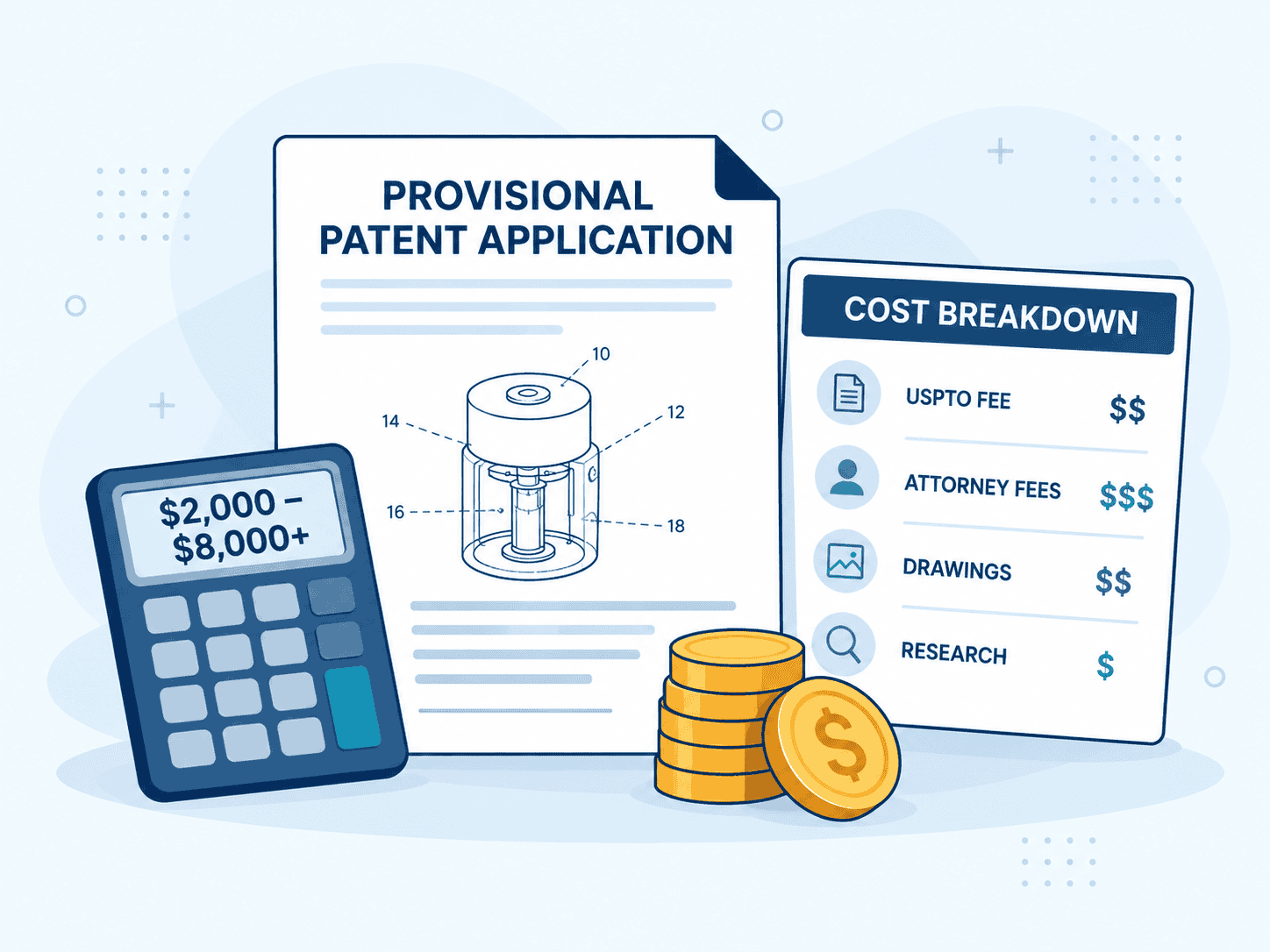
So, how much does a provisional patent cost in practice? For many U.S. applicants, a reasonable planning range is roughly $2,000 to $8,000+ when professional preparation is involved, while a do-it-yourself filing may cost only a few hundred dollars in government fees plus any drawing or research expenses.
This article provides general educational information about U.S. patent practice and is not legal advice for a particular invention.
Key Takeaways
- The current USPTO provisional filing fee is $325 for a large entity, $130 for a small entity, and $65 for a micro entity.
- Government filing fees are usually a relatively small part of the total cost when an attorney prepares the application.
- A professionally prepared provisional application may commonly require a budget of $2,000 to $8,000 or more, depending on the invention and scope of work.
- Drawings, technical complexity, prior-art research, multiple embodiments, and attorney drafting time can increase the total.
- A provisional application is not examined and does not become a patent by itself. A corresponding nonprovisional application generally must follow within 12 months to preserve the benefit of the provisional filing date.
How Much Does a Provisional Patent Cost?
There are really two answers to this question: the USPTO filing cost and the total cost of preparing a useful provisional application.
The government fee is straightforward. Professional preparation is not.
A simple provisional application prepared by an inventor may cost only the filing fee and incidental expenses. A detailed application for software, electronics, medical technology, mechanical equipment, biotechnology, or another technically complex invention may require considerably more work.

A practical cost breakdown can look like this:
| Expense | Typical Cost Consideration |
| USPTO filing fee | 65–325 depending on entity status |
| Professional patent drawings | Varies by number and complexity of drawings |
| Patent or prior-art search | Optional, but may add professional or research costs |
| Patent attorney or patent agent preparation | Often the largest portion of the budget |
| Total professionally prepared provisional application | Common planning range of roughly 2,000–8,000+ |
PatentAttorney.com’s broader guide to how much a patent costs uses a $2,000 to $8,000+ planning range for provisional applications, with technical detail, drawings, attorney drafting time, and invention complexity among the primary cost drivers.
That does not mean every provisional should cost several thousand dollars. It means comparing quotes requires looking at what is actually being prepared.
A $500 filing consisting largely of an inventor’s existing notes is not necessarily comparable to an attorney-drafted application containing detailed embodiments, alternative implementations, technical drawings, and disclosure designed with the later nonprovisional application in mind.
Current USPTO Provisional Patent Filing Fees
As of the USPTO fee schedule currently in effect, the basic provisional application filing fees are:
| Applicant Status | USPTO Provisional Filing Fee |
| Large entity | $325 |
| Small entity | $130 |
| Micro entity | $65 |
The USPTO publishes these amounts in its official patent fee schedule.
Small and micro entity rates can substantially reduce the government portion of the provisional patent cost, but applicants must actually qualify for the applicable status.
There can also be additional USPTO charges in less common circumstances. For example, the current schedule lists an application size fee when a provisional specification and drawings exceed 100 sheets. A surcharge can also apply if the basic filing fee or required cover sheet is submitted after the initial filing.
One important difference from a nonprovisional utility application is that a provisional application does not require separate USPTO search and examination fees. The USPTO does not examine a provisional application on its merits.
That is one reason the initial government fee is relatively low.
It is also why the filing fee should not be confused with the actual cost of preparing the application.
What Makes a Provisional Patent Application More Expensive?
The largest cost variable is usually not the USPTO. It is the amount of work required to adequately document the invention.
Complexity of the invention
Consider two hypothetical inventions.
The first is a straightforward mechanical bracket with a small number of components and one principal configuration.
The second is a software-controlled medical device with sensors, hardware, data processing, several operating modes, alternative configurations, and multiple potential commercial applications.
Both may be filed as provisional applications. They should not be expected to cost the same to prepare.
For the second invention, counsel may need to understand:
- The architecture of the system.
- How components interact.
- Alternative embodiments.
- Data flows or software processes.
- Possible substitutions for major components.
- Which technical features distinguish the invention from existing technology.
- Which variations the company may want protected later.
That work adds drafting time.
Number of embodiments and variations
A patent application should generally describe more than the single prototype sitting on the inventor’s desk.
Suppose an inventor has developed a fastening device using a spring-loaded mechanism. During the disclosure meeting, it becomes clear that the same function could be achieved using magnetic force, hydraulic pressure, or another mechanical arrangement.
Those alternatives can matter.
If the later patent strategy needs protection extending beyond the first prototype, the provisional application needs enough disclosure to support relevant variations. Recording those alternatives requires more work than filing a short description of the current model.
This is one reason a provisional should not automatically be treated as an informal sketch. The USPTO explains that a later nonprovisional receives the benefit of the provisional filing date only for subject matter sufficiently disclosed in the provisional. USPTO guidance on provisional applications makes that relationship explicit.

Patent drawings
Drawings can be another component of the provisional patent cost.
The amount depends on the invention and the type of illustration required. A relatively simple mechanical device may need several views. An electrical invention may require circuit or system diagrams. Software-related inventions may benefit from architecture diagrams, process flows, or interface-related figures where those figures help explain the technical disclosure.
The USPTO requires drawings when they are necessary to understand the invention.
The important point is not whether the drawings look polished. It is whether they help disclose the invention clearly enough to support what may be claimed later.
Prior-art searching
A patent search is not formally required before filing a provisional application, but searching can influence the drafting strategy.
Finding similar patents may reveal that the inventor’s broad concept is already known but that a narrower mechanism or technical improvement appears different. That information can help focus the application on the features most likely to matter.
Inventors doing early research can begin with the process described in this DIY patent search guide, although professional searching and legal analysis may be appropriate when the invention has significant commercial value.
Search costs therefore need to be separated from filing costs when comparing quotes. One firm may quote preparation only, while another proposal may include prior-art searching, analysis, drawings, and strategy discussions.
Patent Attorney Cost for a Provisional Application
There is no standard government-set patent attorney cost or patent lawyer cost for preparing a provisional application.
Legal fees vary because the actual assignment can range from reviewing a well-developed inventor disclosure to building a comprehensive technical description from several meetings, prototypes, engineering documents, and drawings.
A patent attorney preparing a provisional application may need to:
- Interview the inventor or engineering team.
- Identify the invention’s commercially important features.
- Review drawings, prototypes, workflows, source materials, or test results.
- Identify possible alternative implementations.
- Determine what information belongs in the filing.
- Prepare or coordinate patent drawings.
- Draft the specification.
- Review inventorship and filing information.
- File the application with the USPTO.
- Plan for the later nonprovisional filing.
PatentAttorney.com’s article on how a patent attorney helps you file correctly explains why this work involves more than submitting forms. An application has to disclose enough technical detail to support the patent strategy that follows.
That is especially important with provisional applications because formal patent claims are not required.
The absence of a claim requirement makes the filing procedure more flexible. It does not mean the underlying disclosure can safely be vague.
Under U.S. law, a provisional application must include a written description satisfying the applicable requirements of 35 U.S.C. §112(a). The USPTO likewise states that claims and an inventor oath or declaration are not required, but the application still needs a sufficiently detailed written description and any drawings necessary to understand the invention.

What should you ask when comparing attorney quotes?
Do not compare only the final number.
Ask what the quoted patent lawyer cost actually includes.
For example:
| Question | Why It Matters |
| Is the attorney drafting the application from scratch? | Some lower quotes may assume the inventor supplies a nearly complete disclosure. |
| Are attorney meetings included? | Complex inventions may require several rounds of technical discussion. |
| Are drawings included? | Professional drawings may be billed separately. |
| Is prior-art searching included? | Search work can materially change the scope of the engagement. |
| Will alternative embodiments be developed? | A broader disclosure generally requires more drafting work. |
| Is USPTO filing included? | Some quotes separate preparation and filing services. |
| Are government fees included? | USPTO fees may be billed separately from professional fees. |
| Is later nonprovisional work included? | Usually it is a separate engagement and a much larger future expense. |
This makes two proposals much easier to compare.
A $2,000 quote and a $5,000 quote may represent very different amounts of work.
Is a Cheap Provisional Patent Application Worth It?
Sometimes.
A lower-cost filing can make sense when the invention is relatively straightforward, the inventor already has strong technical documentation, the commercial stakes are modest, or the filing is part of a carefully planned strategy.
The problem is assuming that provisional means incomplete is good enough.
A provisional application establishes value primarily through the disclosure it contains.
Imagine an inventor files a four-page provisional describing a device at a high level. Ten months later, counsel prepares the nonprovisional application and discovers that the commercially important feature was never explained in the provisional.
Adding that feature to the new application may be possible, but the applicant may not be entitled to rely on the earlier provisional filing date for that newly added subject matter.
That can become important if relevant prior art, a competitor filing, or the inventor’s own disclosure occurred in the meantime.
This is why the lowest initial provisional patent cost is not necessarily the lowest-cost strategy.
The USPTO describes a provisional application as a way to establish an earlier effective filing date, but it also emphasizes that the later application receives that benefit only for subject matter adequately supported by the provisional.
Remember the next filing expense
A provisional application does not become a patent.
It is not examined, and it normally remains pending for 12 months. To preserve the benefit of the provisional filing date, the applicant generally must file a corresponding nonprovisional application within that period.
That makes budgeting important.
An inventor who spends $4,000 on a provisional application should not assume that $4,000 represents the entire patent process.
The later nonprovisional application is a separate and usually more expensive filing. It normally requires formal claims and triggers USPTO search and examination fees, followed potentially by prosecution costs as the examiner reviews the application.
A provisional filing therefore works best as part of a broader patent budget rather than as an isolated purchase.
When Paying More for a Provisional May Make Sense
A more comprehensive provisional application may be justified when:
- The invention will be publicly launched soon.
- Investors or potential licensees are evaluating the technology.
- Competitors are actively developing similar products.
- The technology has several commercially important embodiments.
- International patent protection may later be pursued.
- The invention is technically complex.
- The filing could become the foundation of an important product or patent portfolio.
- There have already been disclosures, sales discussions, demonstrations, or other events that could affect filing strategy.
In these situations, the filing date can have significant commercial consequences.
A well-prepared provisional application does not guarantee that a patent will issue. It simply gives the later application a better-developed technical record from which to claim the benefit of that earlier filing date.
Conclusion
The government portion of a provisional patent filing is inexpensive: currently $65, $130, or $325, depending on entity status. But those figures do not tell you what it costs to prepare a provisional application that accurately captures a commercially important invention.
For professionally prepared filings, a planning range of roughly $2,000 to $8,000+ is more realistic for many matters, with the final amount driven by complexity, drawings, research, drafting time, and the breadth of disclosure required.
The useful question is therefore not simply, “How cheaply can I file a provisional?” It is, “What does this application need to disclose today so the filing date is actually useful when I file the full application later?”
FAQs
How much does a provisional patent cost if I file it myself?
A DIY provisional application can cost as little as the applicable USPTO filing fee, currently $325 for a large entity, $130 for a small entity, or $65 for a micro entity. Additional costs can arise for drawings, research, application-size fees, or assistance preparing the filing.
How much does a provisional patent cost with an attorney?
A professionally prepared provisional application can commonly require a budget of a few thousand dollars. PatentAttorney.com’s existing cost guide uses a planning range of approximately $2,000 to $8,000+, although technically complex inventions or unusually extensive applications can cost more.
Why is the patent attorney cost much higher than the USPTO filing fee?
The USPTO fee pays the government to receive the application. Attorney fees pay for understanding the invention, developing the disclosure, identifying variations, drafting the application, reviewing drawings, addressing filing requirements, and considering how the provisional will support later patent strategy.
Can I file a provisional patent application without a patent lawyer?
Yes. Applicants can generally prepare and file their own provisional applications. However, drafting quality matters because the earlier filing date benefits later-claimed subject matter only when the provisional adequately supports that subject matter.
Does a provisional patent application need claims?
No. The USPTO does not require formal patent claims in a provisional application. The filing still requires an adequate written description of the invention and any drawings necessary to understand it.
Does the provisional patent cost include the full patent process?
No. A provisional application normally lasts 12 months and is not examined. A corresponding nonprovisional application generally must be filed within that period to preserve the benefit of the provisional filing date, creating a separate set of attorney and USPTO costs.
Is the cheapest provisional patent application a bad idea?
Not automatically. A simple invention supported by excellent inventor documentation may require less drafting work. The risk arises when a low price reflects a thin disclosure that leaves out technical details or variations needed later.