
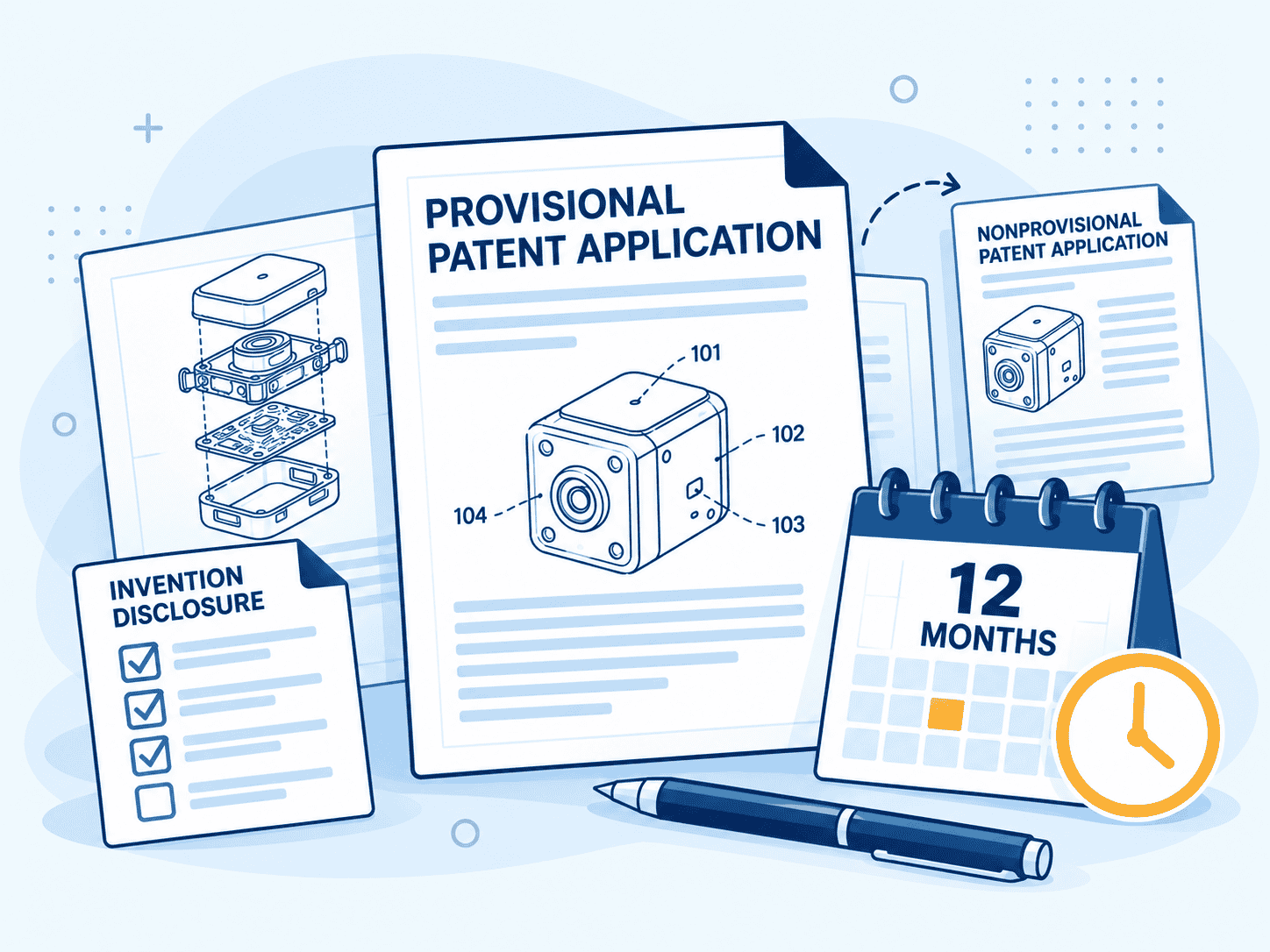
A provisional patent can give an inventor an earlier U.S. filing date without immediately preparing the complete set of documents required for a nonprovisional patent application. That makes it attractive to founders, engineers, product teams, and independent inventors who are still developing an invention, approaching investors, or preparing for a product launch.
But a provisional patent application is not a shortcut around proper patent drafting. It is not examined by the United States Patent and Trademark Office (USPTO), and it never becomes a patent on its own. Its practical value depends largely on what the application actually discloses.
A detailed provisional application can provide a useful foundation for a later patent filing. A thin application that merely describes an idea at a high level may provide far less benefit than the inventor expects.
This guide explains what a provisional patent application is, how much it costs, how to file one, and what a properly prepared application should contain. It also includes a practical example showing why the quality of the initial disclosure matters.
Key Takeaways
- A provisional patent application establishes an early U.S. filing date but does not itself become an issued patent.
- The basic USPTO filing fee is $325 for a large entity, $130 for a qualifying small entity, and $65 for a qualifying micro entity.
- A provisional application normally remains pending for 12 months, during which a corresponding nonprovisional application generally must be filed to claim its benefit.
- Formal patent claims are not required, but the disclosure must contain enough technical detail to support subject matter later claimed.
- The biggest mistake is treating a provisional filing as a placeholder form instead of a substantive description of the invention.
What Is a Provisional Patent Application?
A provisional patent application is a U.S. patent filing authorized under 35 U.S.C. § 111(b). It allows an inventor to establish an earlier filing date for an invention that may later be claimed in a corresponding nonprovisional patent application.
The phrase “provisional patent” is commonly used, but technically, there is no provisional patent. What is filed is a provisional application for patent.
The USPTO does not substantively examine provisional applications or issue patents from them. Instead, the application may provide an earlier effective filing date for adequately disclosed subject matter when the applicant later files a qualifying nonprovisional application.
As explained in the USPTO’s official provisional patent application guidance, filing a provisional application also allows an inventor to use the term “Patent Pending” in connection with the invention.

However, filing does not mean the USPTO has determined that the invention is new, nonobvious, patent eligible, or otherwise patentable. It also does not create an enforceable patent right.
A provisional application can make sense when an inventor needs to establish a filing position while additional development, testing, fundraising, commercial analysis, or patent preparation continues.
Provisional vs. Nonprovisional Patent Applications
The main difference between provisional and nonprovisional applications is what happens after filing.
| Feature | Provisional application | Nonprovisional application |
| Main purpose | Establish an early filing date | Seek examination and patent protection |
| USPTO examination | Not examined | Examined |
| Formal patent claims | Not required | Required |
| Inventor oath or declaration | Not required | Generally required |
| Filing costs | Lower initial government fee | Higher filing and examination costs |
| Duration | Normally pending for 12 months | Continues through examination unless abandoned or otherwise terminated |
| Can directly result in an issued patent? | No | Yes, if requirements are satisfied |
A nonprovisional utility application enters the USPTO examination process. It contains patent claims defining the legal scope of protection the applicant seeks and may eventually issue as a patent if the statutory requirements are satisfied.
The provisional application is therefore best understood as the first filing in a potential patent strategy, not as a cheaper version of an issued patent.
For a closer look at how these application types differ, see the guide to provisional, nonprovisional, and PCT patent applications.
How Much Does a Provisional Patent Cost?
The cost of a provisional patent application depends on two main factors: the government filing fee and the professional work involved in preparing the application.
The USPTO filing fee is relatively straightforward, but attorney fees vary depending on the invention’s complexity and the level of preparation required.
USPTO Provisional Patent Filing Fees
According to the official USPTO patent fee schedule, last revised August 14, 2026, the basic provisional application filing fees are:
| Entity status | USPTO filing fee |
| Large entity | $325 |
| Small entity | $130 |
| Micro entity | $65 |
These amounts represent the basic government filing fees only. They do not include patent attorney fees, technical drawings, prior-art searches, or other professional services.
Applicants must also qualify for small- or micro-entity status before claiming the corresponding fee reduction.
Additional fees may apply in certain circumstances. For example, late submission of the provisional filing fee or cover sheet can trigger a surcharge. Very large applications may also incur application-size fees.
Government fees can change, so applicants should verify the current schedule before filing.
How Much Does a Provisional Patent Attorney Cost?
There is no single attorney fee that applies to every provisional application.
The cost of professional preparation typically depends on:
- Technical complexity: A simple mechanical invention may require less drafting work than a medical device, semiconductor design, or complex software system.
- Quality of existing documentation: Detailed engineering notes, drawings, and technical specifications may reduce the amount of information an attorney needs to develop.
- Number of embodiments: Applications covering multiple configurations, variations, or implementations may require additional drafting.
- Patent drawings: Some inventions need professionally prepared illustrations to communicate their structure and operation clearly.
- Prior-art considerations: The results of earlier patent searches may influence how the invention is described.
- Future filing strategy: An application intended to support a broad nonprovisional filing may require more extensive preparation.
Comparing provisional applications only by price can therefore be misleading.
A short filing may cost less to prepare, but the real question is whether the document contains enough information to support the patent strategy that follows.
For an invention in a crowded technical field, reviewing existing patents may be particularly valuable. The site’s guide on how to do a patent search explains how inventors can identify similar technologies and better understand the prior art before filing.
How to File a Provisional Patent Application
If you’re researching how to file a provisional patent, the actual electronic submission is only one part of the process.
The most important work happens before the documents reach the USPTO.
A complete filing should accurately identify the inventors, describe the invention in sufficient detail, include necessary drawings, and comply with the applicable filing requirements.
1. Identify What the Invention Actually Is
Start by defining the inventive concept in technical terms.
For a physical product, this may include:
- Components and their functions
- Physical relationships between components
- Materials and construction methods
- Operating mechanisms
- Alternative configurations
- Methods of making or using the product
For software inventions, the disclosure may need to explain system architecture, data flows, processing steps, interactions among components, decision logic, and alternative implementations.
A product pitch is rarely enough.
For example, “an app that automatically manages inventory” describes an objective. A useful patent disclosure needs to explain how the relevant invention accomplishes that objective.
The focus should be on the underlying technical solution rather than simply the problem the invention is intended to solve.
2. Prepare a Detailed Written Description
A provisional application must include a written description complying with the applicable requirements of 35 U.S.C. § 112(a).
That generally means providing enough information to demonstrate possession of the disclosed invention and enable a person skilled in the relevant technical field to make and use it without undue experimentation.
A useful drafting question is:
Could a technically knowledgeable reader understand how to make and use the invention from the information provided?
The answer depends on the technology.
A relatively simple mechanical invention might require a straightforward explanation of its components and operation.
A chemical formulation, biotechnology invention, semiconductor architecture, or complex software system may require significantly more technical support.
The description should cover what the inventor has actually developed and any reasonably identifiable alternatives that form part of the invention.

3. Include Drawings When Necessary
Drawings are particularly valuable when the invention involves mechanical structures, physical relationships, system architecture, process steps, or alternative embodiments.
Examples include:
- Exploded views of mechanical assemblies
- Cross-sectional drawings
- Process flow diagrams
- Electrical schematics
- System architecture diagrams
- Different product configurations
Where drawings are necessary to understand the invention, the applicable patent requirements call for them.
An important consideration is that drawings containing essential new technical information cannot simply be added later to repair an inadequate original disclosure.
That makes the filing date a meaningful cutoff.
If an important feature already exists when the application is filed, describe and illustrate it instead of assuming it can safely be added later.
4. Identify the Inventors Correctly
A provisional application must identify the inventor or inventors.
Inventorship is based on contribution to the conception of the invention, not merely job title, company ownership, financial investment, or project management responsibility.
For example, a startup should not automatically list every founder as an inventor.
Likewise, the CEO is not necessarily an inventor simply because the company owns the project.
Inventorship can become more complicated when engineers, contractors, founders, university researchers, and development partners contribute to different aspects of the invention.
Carefully documenting those contributions before filing can help reduce future disputes.
5. Prepare the Cover Sheet or Application Data
A complete provisional filing generally includes a cover sheet or equivalent application data identifying:
- The submission as a provisional patent application
- The names of all inventors
- Inventor residences
- The invention title
- Correspondence information
- Attorney or patent agent information, where applicable
- Applicable U.S. government interests
The USPTO provides Form PTO/SB/16 for provisional application cover sheets. An Application Data Sheet may also be used where appropriate.
6. Submit the Application Through USPTO Patent Center
Applicants can file a provisional application electronically through USPTO Patent Center.
The filing process generally involves preparing the application documents, uploading the files, entering the required information, and paying the applicable government filing fee.
Once the application has been submitted, the applicant should preserve the filing receipt and verify the application number, filing date, inventor information, and other bibliographic details.
The filing date matters because it establishes the starting point for the provisional application’s 12-month period.
What Should a Strong Provisional Patent Include?
A provisional patent application is often described as informal because it does not require the same formalities as a nonprovisional application.
That does not mean the technical disclosure should be casual.
A later nonprovisional application can only receive the benefit of the provisional filing date for subject matter sufficiently supported by the earlier application.
This creates an important practical rule:
Your priority position can only be as strong as the disclosure you actually filed.
Consider an inventor who develops a portable water-filtration device.
The initial prototype uses:
- One filter configuration
- A specific housing shape
- A particular locking mechanism
- One type of replaceable cartridge
However, the inventor already knows that the commercial product could use three cartridge designs and two different locking mechanisms.
A stronger provisional filing would ordinarily describe the known alternatives rather than documenting only the prototype currently being tested.
Why does this matter?
Six months later, when the nonprovisional application is drafted, the applicant may want claims covering those alternative designs.
If the original provisional application never disclosed them, the applicant cannot automatically assume those later claims will receive the original filing date.
Claims Are Optional, but Claim-Focused Preparation Helps
Formal patent claims are not required for a provisional application.
However, thinking about potential claim scope can improve the technical disclosure.
Useful questions include:
- What is the essential inventive feature?
- Which components are optional?
- What could a competitor change while preserving the core idea?
- Are there alternative configurations?
- Does the invention involve both a device and a method?
- Is the underlying invention broader than the current prototype?
These questions encourage a disclosure that captures the technical invention rather than merely documenting one implementation.
A provisional application should also be consistent with the inventor’s broader development plans.
If the engineering team expects meaningful changes over the next several months, those plans may influence what alternatives or embodiments should be documented before filing.
Provisional Patent Example
Consider a startup developing a new bicycle-locking system.
The prototype includes a lock body, a retractable locking member, a sensor, and an electronic release mechanism.
The founders plan to demonstrate the product at an industry event in three weeks, but the engineering team is still deciding whether the commercial version will use Bluetooth, near-field communication (NFC), or another authentication method.
Example of a Weak Provisional Disclosure
A short application might describe the invention as:
“A smart bicycle lock that allows a user to unlock a bicycle using a mobile device.”
That statement identifies a general concept but provides little technical information.
It does not explain how the lock works, how the components interact, or which features distinguish the invention from existing products.
If the applicant later seeks claims covering particular locking structures or authentication mechanisms, the original description may not adequately support them.
Example of a More Detailed Provisional Disclosure
A more useful filing could explain:
- How the locking member engages and disengages
- How the electronic release mechanism operates
- How authentication information is received and processed
- Which component controls the release
- How the system receives power
- What happens when electronic authentication fails
- Alternative authentication methods
- Different physical configurations
- Drawings showing the relationship between the components
The application does not need to predict every future product modification.
But it should document the invention as fully as reasonably possible based on what the inventors know at the filing date.
Suppose the startup later replaces Bluetooth authentication with NFC.
If the original application adequately disclosed NFC as an alternative implementation, that disclosure may support corresponding subject matter in a later nonprovisional filing.
If the original provisional described only the first Bluetooth implementation, the priority analysis may be more complicated.
This example illustrates why the most important question is not simply:
“Can we file something before the product demonstration?”
The better question is:
“What technical subject matter do we need this filing date to support?”
What Happens After Filing a Provisional Patent?
Once a provisional application is filed, the USPTO does not begin substantive patent examination.
Instead, the provisional application’s 12-month period becomes a planning window.
During this time, the applicant may continue engineering, assess commercial demand, approach investors, conduct additional patent research, or prepare the corresponding nonprovisional application.
However, the provisional application does not automatically convert into a nonprovisional application at the end of that period.

The 12-Month Filing Deadline
A provisional application normally remains pending for 12 months from its filing date.
To obtain the benefit of the earlier filing date, the applicant generally must file a corresponding nonprovisional application during that period and properly claim the provisional application’s benefit.
For example:
| Filing event | Example timeline |
| Provisional application filed | January 15, 2026 |
| Product development continues | February–September 2026 |
| Nonprovisional application prepared | October–December 2026 |
| Normal 12-month deadline | January 15, 2027 |
The example assumes no unusual deadline adjustments or other special circumstances.
Applicants should treat the 12-month period as a firm planning deadline rather than an approximate target.
Limited relief may be available when a nonprovisional application is filed after 12 months but within 14 months and the applicable requirements for restoration of benefit are satisfied.
However, this is not a routine extension strategy and should not replace timely filing.
What If the Invention Changes During the Year?
Product development rarely stops after the initial filing.
Suppose an inventor files a provisional application in January. By April, the engineering team has developed a new mechanism that was not disclosed in the January filing.
The original application cannot automatically provide the earlier filing date for technical information it never disclosed.
Depending on the circumstances, the applicant may consider filing another provisional application covering the new subject matter.
A later nonprovisional application may then claim the benefit of multiple provisional applications where the relevant legal requirements are satisfied.
The important consideration is that different claimed features may be entitled to different effective filing dates depending on the supporting disclosures.
This is one reason to keep patent counsel informed as the invention develops rather than waiting until the final month to review everything that changed.
Public Disclosure and International Patent Rights
Inventors sometimes assume that filing a provisional application removes every concern about publication, sales, demonstrations, or fundraising.
It does not.
U.S. patent law provides certain exceptions for inventor-originated disclosures, including a limited one-year grace period in qualifying circumstances.
However, foreign patent laws may apply different rules.
A public disclosure that may fall within a U.S. exception could still interfere with patent protection in some other countries.
For companies planning international protection, patent filing strategy should therefore be addressed before public demonstrations, conference presentations, crowdfunding campaigns, publications, or other potentially public disclosures.
When Does Hiring a Provisional Patent Attorney Make Sense?
Applicants are permitted to prepare and file provisional applications without legal representation.
The difficult part, however, is rarely uploading the documents.
The more demanding questions involve how the invention should be disclosed and how the provisional application fits into a longer-term patent strategy.
A provisional patent attorney or USPTO-registered patent agent can help evaluate questions such as:
- What technical information should the application contain?
- How broadly should the invention be described?
- Which alternative embodiments should be included?
- Who should be named as an inventor?
- Does a prior public disclosure create a timing concern?
- Should a patentability search be conducted first?
- Is the invention sufficiently developed for filing?
- Should international patent protection be considered?
- Would additional provisional filings be useful as development continues?
These questions become especially important when the invention has significant commercial value, multiple contributors, complex technology, international business plans, or an approaching public launch.
Professional assistance can also help connect the initial disclosure to the claims that may eventually appear in the nonprovisional application.
The site’s article on how a patent attorney helps you file correctly explains how professional drafting, filing strategy, and review can reduce problems that might otherwise weaken protection.
The objective is not simply to produce a document with a filing date.
It is to make that filing date useful.
Conclusion
A provisional patent application can be a practical first step for inventors who need an early filing date while continuing to develop a product or prepare a more complete patent filing.
Its lower initial filing cost and reduced formal requirements offer flexibility, but they do not eliminate the need for a detailed technical disclosure.
The most valuable provisional filings document how an invention works, identify meaningful alternatives, and anticipate the subject matter that may eventually be claimed in a nonprovisional application.
Rather than treating the provisional application as temporary paperwork, inventors should approach it as the foundation of their future patent strategy.
FAQs
Does a provisional patent protect my invention?
A provisional patent application does not create an issued patent or independently enforceable patent rights. Its primary function is to establish an earlier filing date that may benefit a later nonprovisional application for adequately supported subject matter. Filing also allows the invention to be described as “Patent Pending.”
How long does a provisional patent last?
A provisional application normally remains pending for 12 months from its filing date. To obtain the benefit of that date, the applicant generally must file a corresponding nonprovisional application within that period and properly claim the provisional application’s benefit.
Can I file a provisional patent myself?
Yes. The USPTO permits inventors to file provisional applications without hiring a patent attorney. However, applicants remain responsible for providing an adequate technical disclosure and satisfying the applicable filing requirements. Professional assistance may be particularly valuable for complex or commercially important inventions.
Do provisional patent applications need claims?
No. Formal patent claims are not required in a provisional application. Nevertheless, the written description must adequately support the subject matter that the applicant may later seek to claim in a corresponding nonprovisional application.
Do I need drawings for a provisional patent application?
Drawings should be included when necessary to understand the invention. Even where they are not strictly required, technical illustrations can help describe component relationships, processes, configurations, and alternative embodiments. Applicants should avoid omitting essential visual information on the assumption that it can be added later without affecting priority.
How much is the USPTO provisional patent filing fee?
Under the USPTO fee schedule last revised August 14, 2026, the basic provisional application filing fee is $325 for a large entity, $130 for a qualifying small entity, and $65 for a qualifying micro entity. These amounts exclude patent attorney fees, drawings, searches, and any additional applicable government charges.
What is the biggest mistake people make with provisional patents?
One of the most consequential mistakes is filing an application that does not adequately describe the invention. A filing date only benefits subject matter that meets the applicable disclosure requirements. Missing technical details, unexplained mechanisms, and omitted alternatives can create problems when the applicant later seeks broader patent claims