
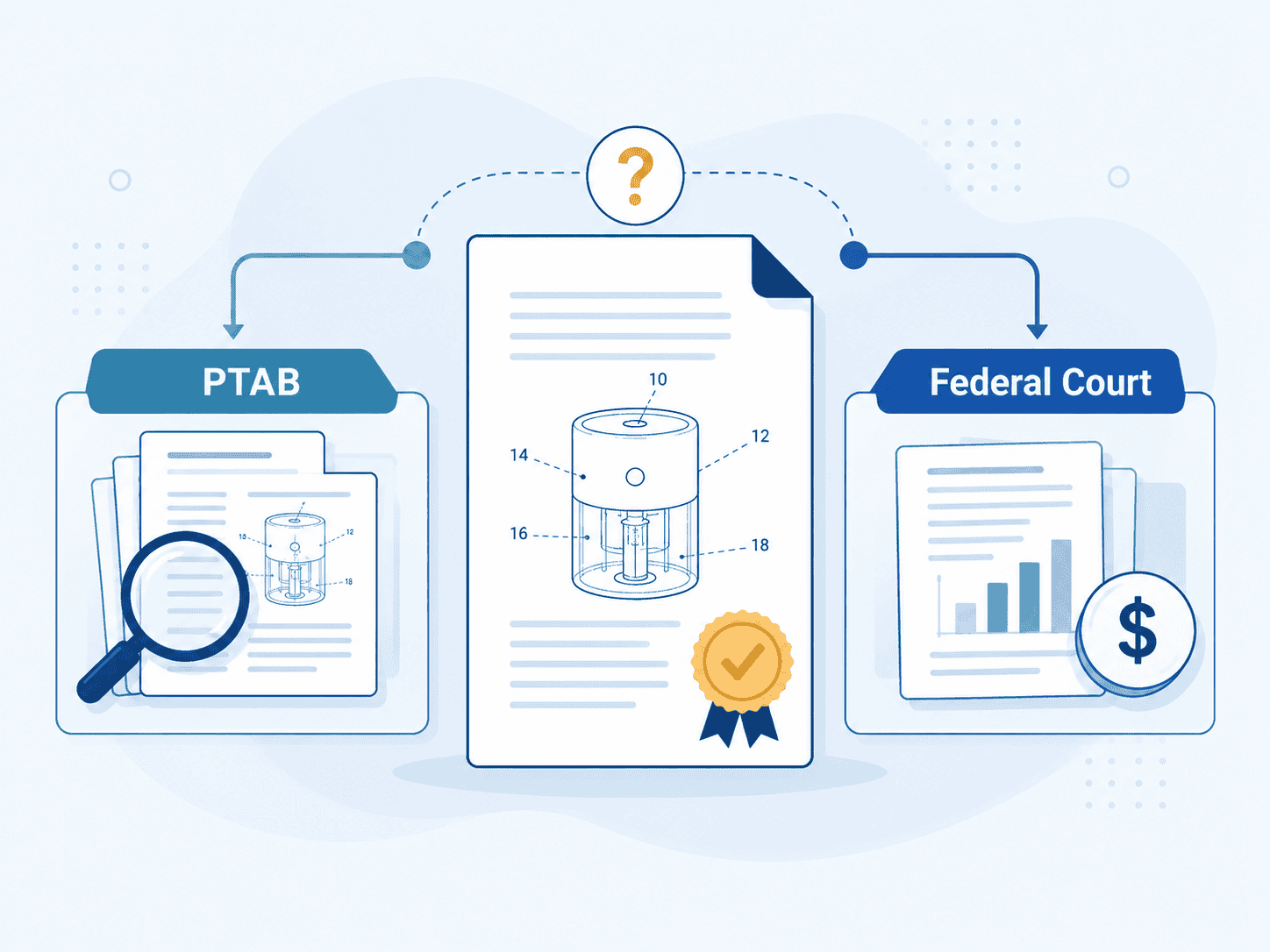
Choosing between PTAB vs federal court is rarely a simple question of which forum is faster or less expensive. The Patent Trial and Appeal Board (PTAB) and U.S. district courts do different jobs, apply different procedures, and can produce very different consequences.
For a company accused of patent infringement, PTAB proceedings may provide a focused way to attack patentability using patents and printed publications. Federal court, however, can address infringement, damages, injunctions, and invalidity arguments that go beyond the scope of an inter partes review. In some disputes, both proceedings run at the same time.
This guide explains the practical differences that should shape patent dispute forum selection. It provides general information about U.S. patent disputes, not legal advice for a particular case.
Key takeaways
- PTAB inter partes review focuses on patentability under Sections 102 and 103 based on patents and printed publications.
- Federal district court can address infringement, damages, injunctions, invalidity, unenforceability, and other defenses.
- An IPR petition can be subject to strict filing deadlines, including the one-year time bar after service of an infringement complaint in many situations.
- A final written decision in an IPR can create estoppel that restricts later invalidity arguments.
- Filing an IPR does not automatically stop an existing infringement lawsuit. Parallel proceedings require coordinated strategy.
Key differences between PTAB and federal court
The easiest way to understand PTAB vs federal court is to start with the question each forum is capable of answering.
An inter partes review (IPR) before the PTAB asks whether challenged patent claims should remain patentable based on particular prior-art grounds. The USPTO’s inter partes review guidance explains that an IPR challenge is limited to grounds available under 35 U.S.C. §§ 102 or 103 and to prior art consisting of patents or printed publications.
A federal district court has a much broader role. It can determine whether a patent has been infringed and, where appropriate, address remedies. It can also hear invalidity defenses. Under 35 U.S.C. § 282, invalidity and noninfringement are among the defenses available in an infringement action.

| Issue | PTAB inter partes review | Federal district court |
| Main question | Are challenged patent claims patentable? | Has a patent been infringed, and what defenses or remedies apply? |
| Invalidity grounds | Sections 102 and 103 using patents or printed publications | Broader statutory invalidity defenses may be raised |
| Infringement decision | No | Yes |
| Monetary damages | No | Yes |
| Injunctive relief | No | Potentially |
| Fact finder | Administrative patent judges | Federal judge and, for eligible issues, potentially a jury |
| Discovery | More limited and proceeding-specific | Broader civil discovery |
| Technical focus | Patentability and prior art | Patentability, infringement, claim construction, damages, and related issues |
| Appeal | U.S. Court of Appeals for the Federal Circuit | Generally U.S. Court of Appeals for the Federal Circuit in patent cases |
That distinction immediately rules out some forum choices. A patent owner seeking compensation for unauthorized use cannot obtain damages through an IPR. Likewise, an accused infringer whose defense depends heavily on issues outside patents and printed publications may need arguments that an IPR cannot resolve.
Readers unfamiliar with the litigation side of patent law may find it useful to first review how patent infringement and enforcement work, because validity and infringement are separate legal questions.
When PTAB may fit a patent challenge
The strongest case for choosing PTAB usually begins with the prior art.
Suppose a software company is sued for infringing a patent covering a particular data-processing method. Its technical team identifies two earlier patents that appear to disclose most of the claimed elements, while another published patent supplies the remaining feature.
That is the type of dispute in which an IPR may deserve close attention. The challenge can be built around anticipation under Section 102 or obviousness under Section 103 using patent and printed-publication evidence.
The PTAB offers a narrower patent invalidation forum
Narrowness can be useful.
Instead of litigating infringement, damages, witness conduct, commercial activity, and numerous defenses at once, the parties can focus on defined patent claims and prior art. PTAB judges also work specifically with patent disputes.
That does not mean the proceeding is simple. An IPR petition must identify the claims being challenged, the grounds for each challenge, and the supporting evidence. Claim construction, expert testimony, prior-art status, technical disclosures, and procedural requirements can all become significant.
The USPTO states that an IPR may be instituted when the petition shows a reasonable likelihood that the petitioner would prevail on at least one challenged claim. If instituted and not dismissed, the Board generally must reach a final determination within one year after institution, subject to statutory exceptions and possible extensions.

Timing can determine whether IPR is available at all
A company cannot assume that PTAB remains available indefinitely.
Under 35 U.S.C. § 315, an IPR generally may not be instituted if the petition is filed more than one year after the petitioner, real party in interest, or privy has been served with a complaint alleging infringement of the patent.
There is another important sequencing issue. If a party first files certain civil actions challenging the validity of the patent, Section 315(a) can prevent it from later obtaining IPR institution.
Those rules make early case assessment important. Waiting until district court litigation is well advanced before considering PTAB may eliminate an option that was available at the start.
Prior-art preparation matters more than volume
A practical mistake is treating an IPR as an opportunity to collect as many prior-art references as possible.
A stronger approach starts with the actual claim language. For each challenged claim, counsel and technical experts can identify which limitations appear in which references, whether those references qualify as prior art, and how the proposed combination fits the asserted legal ground.
That process resembles some aspects of an early patent prior art search, but litigation-oriented searching is different from a general patentability search. The relevant dates, claim limitations, evidentiary requirements, and litigation record can materially affect which references matter.
When federal court may be necessary
Federal court patent litigation does much more than determine whether claims should survive.
A patent owner typically uses district court when seeking a finding of infringement and remedies against an accused infringer. An accused party can respond with noninfringement and invalidity defenses and may raise other issues that cannot be decided in IPR.
The Federal Judicial Center’s Patent Case Management Judicial Guide describes patent cases as complex civil matters that can involve claim construction, extensive discovery, expert testimony, dispositive motions, and parallel PTAB proceedings.
Federal court can consider a broader factual record
Consider a different dispute.
A manufacturer is accused of infringing a mechanical patent. Its defense is not based only on earlier patents. It believes the patent claims fail for reasons involving the specification and statutory requirements outside the limited Section 102 and 103 patent-and-publication grounds available in IPR.
Federal court may be important because the defense cannot simply be repackaged into an IPR petition.
The same is true when the central question is noninfringement. PTAB does not decide whether an accused product contains every limitation of an asserted claim. That comparison belongs to the infringement case.

Discovery is broader in district court
Federal litigation can involve document production, interrogatories, depositions, source code or technical records, expert discovery, and evidence related to sales and damages.
That breadth has a cost. More discovery can mean more work, more contested issues, and more opportunities for motion practice.
But broad discovery can also be necessary. If the case turns on how an accused system operates, what a company sold, how damages should be calculated, or what witnesses knew, the evidence may exist outside the patent record.
This is why a simple PTAB cost vs litigation comparison can be misleading. A narrower administrative challenge and a full infringement action are not interchangeable products. They answer different questions.
How parallel proceedings change the strategy
One of the most important patent forum strategy issues is that choosing PTAB does not necessarily mean leaving federal court.
An accused infringer may be defending a district court lawsuit while also pursuing an IPR against the asserted patent. These parallel proceedings patent disputes require decisions about timing, claim overlap, stays, expert positions, prior art, and estoppel.
Filing an IPR does not automatically stay an infringement case
If a defendant files an IPR petition after being sued, the district court action does not automatically disappear.
A party may ask the district court to stay litigation while the PTAB proceeding moves forward, but whether a stay is entered depends on the circumstances and the court’s application of the relevant legal standards.
That creates a practical planning problem. A company should not build its budget or litigation schedule on the assumption that PTAB will replace district court proceedings.
There may instead be a period when both matters require substantial attention.
The PTAB timeline and court timeline can interact
An IPR has several important stages: petition, preliminary response, institution decision, trial if instituted, and final written decision.
District court litigation has its own schedule, which can include pleadings, discovery, claim construction, expert reports, summary judgment, and trial.
The value of an IPR can therefore depend partly on where the court case is when the PTAB reaches its major milestones. A petition filed early in litigation presents a different procedural situation from one filed close to a major district court deadline.

Estoppel can reshape later defenses
Estoppel is one of the most consequential differences in an IPR vs district court strategy.
When an IPR reaches a final written decision, Section 315(e) can prevent the petitioner, its real party in interest, or its privy from later asserting certain invalidity grounds that were raised or reasonably could have been raised during the IPR.
This means selecting PTAB grounds is not merely about maximizing the immediate chance of invalidating claims. Counsel also has to consider what a final written decision could do to the district court defense.
For example, assume a defendant identifies six potentially useful printed-publication combinations. It selects only two for its IPR petition and holds the others for litigation. That does not necessarily preserve those other combinations for district court. Depending on the circumstances, the estoppel statute may restrict later reliance on grounds that reasonably could have been raised during the IPR.
Forum strategy therefore needs to be planned as one coordinated defense, not as two independent cases.
How to compare PTAB vs federal court
The question “where to challenge a patent?” is better answered by mapping the dispute before selecting the forum.
Start with the claims being asserted. Then identify the defense theories, available evidence, procedural deadlines, and business objective.
Ask what result you actually need
If the goal is to cancel patent claims based on strong patent or printed-publication prior art, PTAB may offer a focused route.
If the dispute requires a ruling on noninfringement, damages, injunctions, contractual issues, or broader invalidity defenses, district court may be essential.
A patent owner considering enforcement has a different starting point from an accused infringer. PTAB is principally a patentability forum. It is not a forum for obtaining infringement damages.
Separate prior-art strength from overall case strength
A party can have an excellent noninfringement defense and a poor IPR case.
The reverse is also possible. A product may appear to fall within the asserted claims, but earlier publications may create a serious validity challenge.
Those positions should be assessed independently.
A useful internal case review might create three separate workstreams:
- Map asserted patent claims against the accused product.
- Map potentially invalidating prior art against those claims.
- Identify defenses that depend on evidence or statutory grounds unavailable in IPR.
Seeing those analyses side by side makes patent challenge venue decisions more concrete.
Check deadlines before debating tactics
Forum analysis loses value if the preferred option is already time-barred.
For an accused infringer, the date of service of the infringement complaint should be identified early because of the Section 315(b) deadline. Counsel should also examine previous actions involving the patent, real parties in interest, related entities, and other facts that may affect PTAB eligibility.
Do not treat the one-year period as a target filing date. Preparing an IPR petition involves prior-art searching, technical analysis, expert work, claim mapping, and legal drafting.

Model the consequences of both success and failure
A useful forum analysis should consider more than the desired outcome.
If the PTAB institutes review, what happens to the district court schedule? If it declines institution, what litigation work remains? If claims survive a final written decision, which invalidity theories will still be available? If claims are cancelled, how does that affect the infringement case?
The same exercise applies in court. Consider the expected discovery burden, claim construction issues, technical expert needs, remedies, and potential trial path.
This is more useful than asking which forum is “cheaper” in isolation.
Assess settlement pressure realistically
Patent disputes often settle, but forum selection can change negotiating positions.
An instituted IPR may alter how both sides view patent validity. A denied petition may have the opposite effect. Claim construction or summary judgment decisions in district court can also change the commercial value of continuing.
None of those events guarantees settlement. They simply change the information available to the parties.
Conclusion
There is no universal answer to PTAB vs federal court because the two forums are designed to resolve different parts of a patent dispute.
The practical choice begins with four questions: what legal issue must be decided, what evidence supports it, what deadlines apply, and what consequences would follow from the proceeding. When litigation and PTAB are both possible, they should be planned together, especially because timing and IPR estoppel can affect the defenses available later.
For an actual patent dispute, those questions should be reviewed with patent litigation counsel using the specific patent claims, complaint, prior art, procedural history, and business objectives involved.
FAQs
Is PTAB better than federal court for challenging a patent?
Not in every case. PTAB can be well suited to challenges based on Sections 102 or 103 using patents and printed publications, while federal court can address a broader range of invalidity defenses as well as infringement and remedies. The evidence and objectives of the particular dispute determine which forum is relevant.
Can I challenge the same patent at the PTAB and in federal court?
Parallel PTAB and district court proceedings can occur. An accused infringer may petition for IPR while defending an infringement suit, although statutory restrictions, filing deadlines, estoppel, and the possibility of a litigation stay need to be considered.
Does filing an IPR automatically stop a patent lawsuit?
No. Filing an IPR petition does not automatically stay an existing infringement case. A defendant may request a stay, but the district court determines whether the litigation should be paused under the circumstances.
What patent validity arguments can be raised in an IPR?
Inter partes review is limited to challenges under 35 U.S.C. §§ 102 and 103 based on prior art consisting of patents or printed publications. Other invalidity theories may need to be addressed through another procedure or in federal court.
How long do I have to file an IPR after being sued?
Under 35 U.S.C. § 315(b), an IPR generally cannot be instituted when the petition is filed more than one year after the petitioner, real party in interest, or privy is served with a complaint alleging infringement of that patent. Specific procedural histories can raise additional issues, so the deadline should be evaluated promptly.
Can the PTAB award patent infringement damages?
No. An IPR determines the patentability of challenged claims. Monetary damages for infringement and other infringement remedies are matters for federal court.
What is IPR estoppel?
After an IPR results in a final written decision, 35 U.S.C. § 315(e) can restrict the petitioner from later asserting certain invalidity grounds that it raised or reasonably could have raised during the IPR. Because that can affect a parallel district court defense, estoppel should be considered before an IPR petition is filed.